
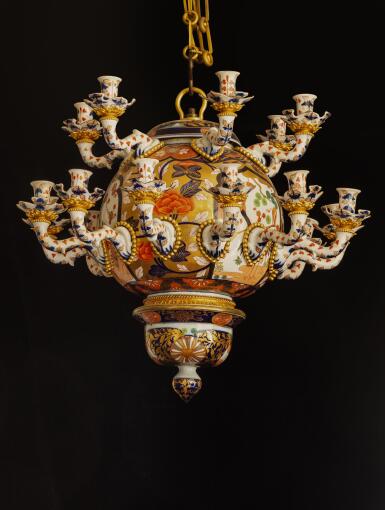
A European gilt-bronze and polychrome porcelain eighteen-light chandelier, circa 1845
No reserve
Estimate
8,000 - 12,000 EUR
Lot Details
Description
imitating Imari porcelain, on two levels
Haut. 65 cm, diam. 60 cm ; Height 25 2/3 in, diam. 23 2/3 in
Our chandelier was originally a globular vase inspired by Asian productions, possibly conceived by a luxury goods dealer in the 19th century. The body was carefully pierced with eighteen holes to allow for the attachment of the arms, likely made specifically for this purpose. The lid, originally corresponding to the vase’s foot, was repositioned to serve as a terminal finial for the chandelier.
During the 19th century, Europe experienced a pronounced fascination with the Orient, fuelled by the expansion of trade, travel, archaeological discoveries, and colonial growth. This taste for distant cultures found expression in the decorative arts, architecture, and fine arts through Orientalism, Chinoiserie, and Japonisme. Porcelain, lacquer, silks, exotic motifs, and forms inspired by Asia were incorporated and reinterpreted according to European aesthetics, reflecting a fascination with the perceived exoticism, luxury, and refinement of the Orient. European production centres retained the spirit of Japanese porcelains exported through the port of Imari, while adapting them to European tastes: more symmetrical compositions, stylised floral motifs, and vessel profiles conforming to European porcelain standards.
This type of decoration was particularly appreciated in England, notably by the Royal Doulton, Derby, and Spode manufactories, which produced table services, vases, and decorative objects of great luxury and refinement.
This mounted chandelier also relates to a fashion popularised in Russia by the bronzier Félix Chopin, who notably produced lighting fixtures in gilt bronze and Imari-style porcelain for prestigious imperial residences, including the Yusupov Palace in Saint Petersburg and the Kremlin in Moscow (for a comparable example, Bonhams, London, 9 July 2015, lot 79).
Finally, the earliest pieces, bearing the mark “Bayeux,” display motifs applied to the glaze with contrasting matte and burnished gilding, sometimes enriched with small polychrome flowers in a style inherited from the 18th century. The most celebrated porcelains of the Langlois period (1812–1849) feature blue, red, and gold decoration inspired by Far Eastern porcelains.