
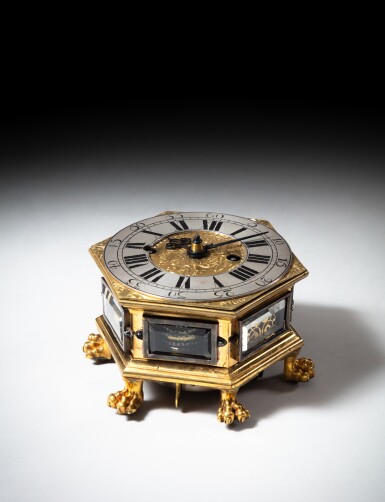
A gilt-bronze, silvered bronze and brass hexagonal table clock, Nicolaus Johansen, Riga, circa 1700
No reserve
Estimate
3,000 - 5,000 EUR
Lot Details
Description
the dial with silvered chapter ring and signed to the engraved centre Nicolaus Johansen, Riga, the two-train movement with chain fusee to the going train, verge escapement with engraved and pierced balance cock, base-mounted bell, the backplate signed as the dial, the moulded hexagonal case with glazed side panels, on paw feet; in a fitted red leather-covered box with viewing panel to the top and wax seals (a cross, initials BW and an anchor)
Long. 14 cm, width. 5 ½ in
Technical innovations in clockmaking in the 15th and 16th centuries, such as the barrel spring and escapement, made it possible to produce portable clocks such as our table clock. The Germanic countries specialized in this hexagonal clock, which usually rested on claw feet, with the dial on top so that the time could be read while seated. Nuremberg became the centre of production for these clocks, but other countries adopted the same design. Our table clock is signed by Nicolaus Johansen, a clockmaker in Riga in the Baltic countries. Little is known about this clockmaker, but a similar table clock was sold at Replica Shoes 's, New York, 26 April 2001, lot 36.
Gilt-bronze examples from the same period are preserved in public collections such as the Metropolitan Museum in New York, the Rijksmuseum in Amsterdam and the Victoria and Albert Museum in London.