
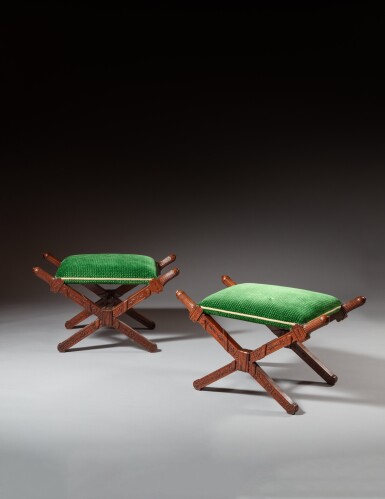
A pair of Consulate mahogany stools, circa 1800, attributed to Jacob Frères
Estimate
25,000 - 40,000 EUR
Lot Details
Description
X-shaped supports as swords, decorated with palmettes, scrolls, and rosettes, joined by a stretcher with double baluster, with a green velvet upholstery by Maison Decour
(2)
Height 47 cm, width. 77 cm, depth 47 cm ; Height 18 1/2 in, width 30 3/8 in, depth 18 1/2 in
S. Faniel, Le XIXe siècle français, 1957, Paris, ill. p. 67
Related literature
H. Lefuel, Jacob Desmalter, Villeneuve-Saint-Georges, 1925
M. Beurdeley, Georges Jacob (1739-1814) et son temps, Saint-Rémy-en-l’Eau, 2002
C. H. de Quénetain, Les styles Consulat et Empire, Paris, 2005, p. 38-39
J.-P. Samoyault, Mobilier Français Consulat et Empire, Paris, 2009, p. 54 et p. 66
This pair of stools rests on X-shaped supports in the form of antique sword scabbards, carved with palmettes, scrolls, and floral motifs, and joined by a central double-baluster stretcher.
This martial vocabulary is also found in the furniture of certain chairs made around 1800 for the Sénat conservateur at the Palais du Luxembourg, where the backs feature trophies-of-arms motifs in place of traditional openwork designs.
This X-shaped form was taken up again under the Empire in a series of X-shaped stools designed by Bernard Poyet, made by Jacob-Desmalter, and delivered around 1804 on the occasion of Napoleon’s coronation and his reception at the Corps législatif (Victoria & Alibert Museum, London, inv. W.3-1956).
Jacob Frères (1796-1803)
Jacob frères stands for the partnership between Georges II Jacob (1768–1803) and François-Honoré-Georges Jacob (1770–1841), the two sons of the famous chair maker Georges Jacob (1739–1814). Over the course of several years, the two brothers worked tirelessly to develop the family workshop on Rue Meslée and sought to create new models of chairs and furniture. This ambition marked a turning point in the history of furniture with the design of pieces featuring metal supports or structures, which Jacob Frères went on to develop, such as the gueridon with four legs topped with an eagle with outstretched wings (sold at Replica Shoes 's, London, 9 June 2004, lot 126) and its counterpart at the Hermitage in Saint Petersburg. This constant renewal and the quality of their work enabled them to meet the demands of their private clientele and the Garde-meuble, notably by participating in most of the major furnishing campaigns aimed at refurnishing the former royal palaces and châteaux.
In 1803, after the death of his eldest son, Georges Jacob Sr. resumed an active role in the workshop alongside his second son; this new partnership gave rise to furniture and chairs stamped or marked ‘Jacob Desmalter/Rue Meslée’.