
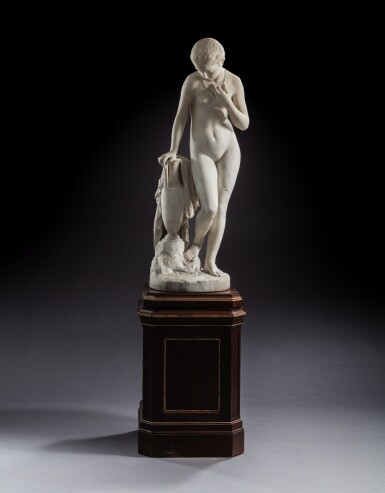
Auguste Joseph Truphème
Jeune fille à la source (Maiden at the Spring)
Estimate
50,000 - 80,000 EUR
Lot Details
Description
André François Joseph Truphème
1820 - 1888
Jeune fille à la source (Maiden at the well)
white marble, on a rotating oak pedestal
signed Fois Truphème.
marble: 140.5cm., 55¼in.
pedestal: 90 by 60 by 59cm., 35⅜ by 23⅝ by 23¼in.
Couturier-Nicolay, Paris, Hôtel Drouot, 26 March 1984, lot 48.
Sculptures du XVIIe au XXe siècle, Musée des Beaux-Arts de Lyon, Lyon, 2017, pp. 242-43, under no. 95.
Born in Aix-en-Provence, Truphème moved to Paris in 1840 and entered the École des Beaux-Arts in 1846. In the studio of Jean-Marie Bonnassieux, he formed close ties with two other young pupils of the sculptor, Alexandre Falguière and Frédéric Auguste Bartholdi. He exhibited at the Salon for the first time in 1850 and received several distinctions during the 1850s and 1860s. His work alternates between portraits and allegorical subjects, whose compositions, although shaped by a strictly academic training, are imbued with a certain originality and poetic sensibility. He also collaborated on major Parisian building projects under the Second Empire and the Third Republic, notably at the Louvre, the Opéra, and the Hôtel de Ville. He further contributed to the decorative programs of the Palais de Justice and the Palais Longchamp in Marseille, as well as to the Fontaine de la Rotonde and the Palais de Justice in his native city. Several of his works are preserved in the Musée Granet, Aix-en-Provence, and in the Musée des Beaux-Arts de Marseille.
Truphème exhibited the plaster model of the Jeune fille à la source (Maiden at the Spring), a personal initiative intended to secure a marble commission, at the 1864 Salon (private collection). Three years later, he presented the marble version of the same model at the Paris Exposition Universelle, where, with the support of several members of parliament, it was acquired by the State for 7,000 francs. The marble was shown again at the Vienna Exposition Universelle in 1873, before entering successively the Musée du Luxembourg and the Louvre, and was subsequently sent to the Musée des Beaux-Arts de Lyon (inv. B 478, on deposit from the Musée d’Orsay since 1986).
Apart from the marble of 1867, the present example of the same size is the only known replica of the model. Although fully consistent with academic ideals, the delicate features of this nude young woman, depicted in a gentle contrapposto, are enlivened by a graceful expressiveness.