
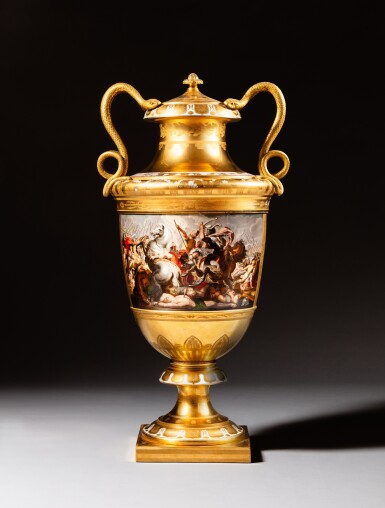
A very large gilt bronze-mounted Vienna porcelain vase and cover, dated 1818
Estimate
20,000 - 30,000 EUR
Lot Details
Description
affixed with double snake-form handles in gilt-bronze, painted, by Leopold Lieb, signed and dated twice Leop: Lieb. 1818., with two large panels, after Rubens, with battle scenes depicting the death in battle and laying in state of a Roman general, separated by gilt panels reserving lightening bolt devices, with tooled gilt-foliate borders to the waisted neck and foot, the cover with similar borders, set on a square base, impressed date code 817, numerals, numeral 114 in manganese
Haut. 100 cm, Height 39 1/4 in.
Sotheby's, Zurich, 5 December 1991, lot 259.
Related Literature
R. Baumstark, Peter Paul Rubens: The Decius Mus Cycle, Liechtenstein. The Princely Collections, exhibition catalogue, Metropolitan Museum of Art, New York, 1985.
The ‘Decius Mus’ cycle by Peter Paul Rubens (1577-1640), is considered among the greatest works in the Princes of Liechtenstein Collections. The monumental sequence, acquired by Prince Johann Adam Andreas I von Liechtenstein (1657–1712) in 1693, tells the victory and death of the Roman consul Decius Mus across eight paintings. The series is believed to be the first pictorial rendering of the battle fought by the Roman general Decius Mus against the Latins (340–338 BCE).
The present vase was painted by Leopold Lieb, after paintings from the Ruben’s cycle, ‘The Death of Decius Mus’ and ‘The Obsequies of Decius Mus’. A second vase of this form, painted by Lieb in 1817 with ‘Decius Mus Relating His Dream’ and ‘The Interpretation of the Victim’ from the cycle, sold at Christie’s, London, 2 July, 1990, lot 120. That vase, smaller at 81 cm high, and its pendant depicting ‘The Consecration of Decius Mus’ and ‘The Dismissal of the Lictors’, also painted by Lieb, have been reunited and are now with Pascal Izarn, Paris. It is highly likely that the pair formed a garniture of three vases with the present vase, which being the largest of the three was reserved for, arguably, the most dramatic scenes from the Rubens cycle.
The painter Leopold Lieb (1771-1836) studied from 1792 under Füger at the Academy of Art in Vienna and is recorded as having worked at the Vienna porcelain manufactory from 1800-36. In 1816, Lieb painted copies on canvas of the six larger paintings from the ‘Decius Mus’ cycle and are today retained at MAK, The Museum of Applied Arts, Vienna, inv. nos. MAL 412- MAL 417. A Vienna porcelain rectangular plaque, painted with ‘The Interpretation of the Victim’, is in the Liechtenstein Collections, Vienna, inv. no. PO 2104. The numeral '114' seen on the present vase is for Johann Teufel, who worked as a gilder at the Vienna porcelain factory from 1797-1845.