
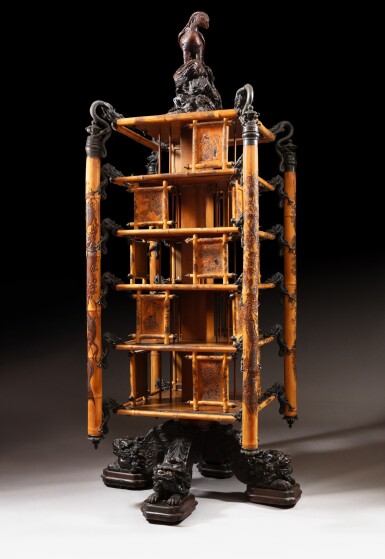
A Japanese patinated bronze mounted bamboo and mother-of-pearl turning bookcase, Meiji period, by Kusamae Iwato To Dai, last quarter of 19th century
Estimate
40,000 - 60,000 EUR
Lot Details
Description
surmounted by a wood eagle, resting of four dragoon-shaped feet, with mother-of-pearl eyes, engraved on all faces with landscapes and characters sometimes lacquered, on the mounts with patinated bronze dragoons, signed on the panels Dainihon Kobe Kusamae Iwato ToDai Nihon, "Grand Japon, Kobe"
Haut. 253 cm, larg. 90 cm, prof. 90 cm; Height. 99 5/8 in, width 35 ½ in, depth. 35 ½ in
Please note that this lot contains restricted materials. Replica Shoes 's is not able to assist buyers with the shipment of any lots containing restricted materials into the U.S.A. Buyer's inability to export or import these lots cannot justify a delay in payment or a sale's cancellation.
This magnificent rotating bamboo bookcase is decorated with Japanese folklore motifs such as dragons on the uprights and large dragon heads serving as feet, as well as a beautifully crafted, naturalistic eagle at the top of the piece. The bamboo work featuring characters in landscapes bearing the artist's signature is also noteworthy.
Bamboo is an essential material in Japan. It is used in construction, tableware and decorative arts such as walking sticks and sword sheaths. On our bookcase, it is assembled in large canes but also in panels, some of which are lacquered, making the bamboo waterproof.
This imposing piece reflects the skill of Japanese craftsmen and artists and could well have been created to showcase this dexterity at the World's Fairs of the late 19th century, such as those held in Paris in 1867, 1878, 1889 and 1900, and in Melbourne in 1880.
Indeed, during the reign of Emperor Meiji, Japan opened up to the world, which discovered the decorative arts of the Land of the Rising Sun, which became a real fashion, and Japonism was born.
During the World's Fairs, the organizing countries were eager to invite Japan, which was able to present its most beautiful pieces and showcase its ancestral arts, such as bamboo work and sculpture, with their own decorative vocabulary.
Our rotating library was used to display the Sutras or canonical Buddhist books. This mobility is intentional, allowing the reader to turn the library like prayer wheels. Thus, instead of reading the sutras, the officiant can pray in the same way. This decorative but also religious invention is attributed to Fu Dashi (497-569) during the Liang dynasty (502-557). This lay Buddhist is said to have created the Shuanglin Temple and participated in the compilation of several Buddhist canonical texts. He is also said to have created these rotating libraries, which were found in the Zangjing ge, a meditation space for reading sutras. A giant rotating library can be seen at the Hase-Dera Temple in Kamakura, Japan.