
Property from an Important New York Private Collection
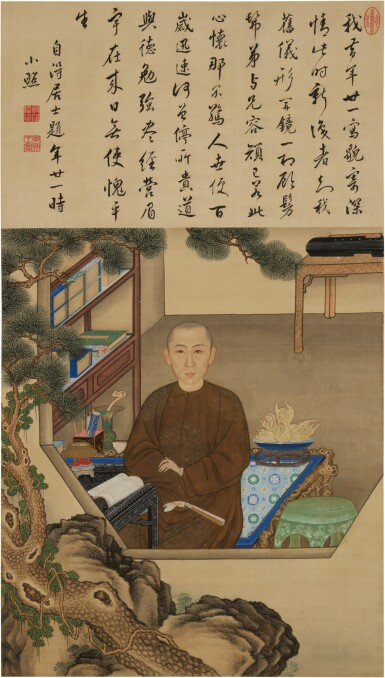
A rare imperial portrait of Prince Guo, aged 21, circa 1718
Live auction begins on:
March 25, 01:30 PM GMT
Estimate
40,000 - 60,000 USD
Lot Details
Description
ink and color on silk, mounted, with a later seventy-character colophon (which reflects on the passage of time and the changes brought by age, prompted by self-examination, and concludes that only moral cultivation gives lasting meaning, so that one may face the future without regret) and signed zide jushi (Prince Guo), and three seals of Prince Guo
35⅞ in., 91 cm; Width 20¼ in., 51.5 cm
Collection of Richard G. Pritzlaff (1902-1997).
Sotheby's New York, 22nd March 2001, lot 138.
Norton Museum of Art, West Palm Beach, 2013 (on loan).
Aisin Gioro Yunli, the first to bear the title of Prince Guo of the First Rank (1697-1738), was the seventeenth son of the Kangxi Emperor and a renowned scholar and artist. Awarded the title of junwang (Prince of Second Rank) by his fourth brother, the Yongzheng Emperor, who succeeded their father as emperor, Yunli (born Yinli but changed to avoid a naming taboo) was promoted to First Rank Prince (qinwang) in 1728.
Unlike many of his brothers and cousins, Prince Guo appears never to have been interested in the battle for succession. Intelligent, calm and scholarly, the prince led a successful career managing the Court of Colonial Affairs, the Three Storehouses of the Ministry of Revenue, and administrative affairs in the Ministry of Revenue; and was appointed Grand Minister by the Qianlong Emperor.
During the reign of the Yongzheng Emperor (r. 1722-35), Yunli had moved to the Zide Yuan, a residence bestowed upon him by the Emperor, where he would live out his days. Prince Yunli was skilled at painting, exacting in calligraphy, and fond of poetry. Famous works attributed to the Prince include Chunhetang ji [Hall of Spring Harmony Writings] and Jingyuanzhai shiji [Poetry from the Calm and Distant Study].
Judging by the relatively large number of extant portraits of the prince, it seems likely that Yunli was particularly fond of having his portrait taken, though the present appears to be the earliest surviving example. Compare three closely related portraits of Prince Guo preserved in important public institutions: one of the prince in his garden by famed court painter Jiang Tingxi (1669–1732), preserved in the Palace Museum, Beijing illustrated in Qingshi tudian. Yongzheng chao [An illustrated dictionary of Qing history. Yongzheng court], Beijing, 2002, p. 58; another of the 32 year-old prince completed by court painter Mangguli (1672–1736) in 1729, in the Nelson-Atkins Museum of Art, Kansas City (accession no. 33-1534) (Fig. 1), illustrated in Deborah Emont Scott, ed., The Nelson-Atkins Museum of Art: A Handbook of the Collection, Kansas City, 2008, p. 373, fig. 278, accompanied by a closely related inscription by the prince; and the 1731 portrait, also by Mangguli, preserved from the Collection of Richard G. Pritzlaff (1902-1997) in the National Museum of Asian Art, Washington (accession no. S1991.95) (Fig. 2), included in Worshipping the Ancestors. Chinese Commemorative Portraits, Arthur M. Sackler Gallery, Washington, 2001, cat. no. 2.13.
Richard G. Pritzlaff (1902-1997) was one of the most important collectors of Chinese portraiture. Assembled during the 1930s and 1940s, Pritzlaff’s collection was apparently acquired en masse from the stock of legendary Beijing dealer-collector Wu Laixi (d. ca. 1949), whom he met on his travels to China in 1937. In 1991, Pritzlaff, who was a rancher of Arabian horses by trade, left eighty-five of his portraits to the Sackler Gallery (now the National Museum of Asian Art), Washington D.C. through a combination of gifts and sale, with the remaining property retained by the family or sold at auction to benefit The Nature Conservancy.
You May Also Like


