
The Cindy and Jay Pritzker Collection
Vincent Van Gogh
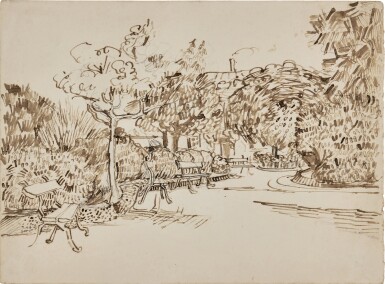
Jardin public avec bancs à la Place Lamartine
Auction Closed
November 20, 11:43 PM GMT
Estimate
2,000,000 - 3,000,000 USD
Lot Details
Description
The Cindy and Jay Pritzker Collection
Vincent van Gogh
(1853 - 1890)
Jardin public avec bancs à la Place Lamartine
reed pen and ink and pencil on paper
10 ⅛ by 13 ¾ in. 25.8 by 34.8 cm.
Executed in late April 1888.
The authenticity of this work has been confirmed by the Van Gogh Museum, Amsterdam.
Theo van Gogh, Paris (acquired by descent from the artist)
Johanna van Gogh-Bonger and Vincent Willem van Gogh, Amsterdam and Laren (acquired by descent from the above)
J.H. de Bois, Haarlem (acquired from the above in 1912)
Dr. Heinrich Stinnes, Cologne-Lindenthal (acquired from the above on 7 April 1928)
Stuttgarter Kunstkabinett, 26 April 1951, lot 1345
Auctiones AG., Basel, 24 January 1970, lot 81
Heinz Berggruen Galerie, Paris (acquired by 1970)
Kornfeld und Klipstein, Bern, 20-22 June 1979, lot 461
Alice Adam, Chicago (acquired at the above sale)
Acquired from the above on 3 July 1979 by the present owner
Amsterdam, Stedelijk Museum, Tentoonstelling van schilderijen en teekeningen door Vincent van Gogh, 1905, no. 471 (titled In een park)
Cologne, Kunstverein and Frankfurt, Moderne Kunsthandlung Marie Held, 1910, no. 34 (titled Tuin met bank, huis op de achtergrond)
Frankfurter Kunstverein, Vincent van Gogh. Zeichnungen und Aquarelle, 1970, no. 59, p. 92; pl. 59, illustrated (titled Vue de Jardin and dated September 1888)
Jacob-Baart de la Faille, L’Oeuvre de Vincent van Gogh, catalogue raisonné, Paris, 1928, no. 1487, vol. III, p. 147; vol. IV, pl. CLXV, illustrated (titled Vue de Jardin)
Jacob-Baart de la Faille, The Works of Vincent van Gogh, His Paintings and Drawings, Amsterdam and London, 1970, no. 1487, p. 519, illustrated (titled The Park and dated September 1888)
Charles W. Millard, “A Chronology for Van Gogh's Drawings of 1888,” Master Drawings, vol. XII, no. 2, 1974, pp. 161 and 165 note 64
Jan Hulsker, “The Intriguing Drawings of Arles,” Vincent, Bulletin of the Rijksmuseum Vincent van Gogh, vol. 3, no. 4, 1974, no. F 1487, pp. 28 and 30 (titled The Park)
Jan Hulsker, The Complete van Gogh, Paintings, Drawings, Sketches, New York, 1980, no. 1410, p. 320, illustrated (dated April-May 1888)
Walter Feilchenfeldt, Vincent van Gogh and Paul Cassirer, Berlin, The Reception of van Gogh in Germany from 1902-1913, Amsterdam, 1988, no. F 1487, p. 135 (titled The Park)
J.F. Heijbroek and E.L. Wouthuysen, Kunst, kennis en commercie. De kunsthandelaar J.H. de Bois (1878-1946), Amsterdam and Antwerp, 1993, p. 205
Liesbeth Heenk, Vincent van Gogh's Drawings, An Analysis of their Production and Uses, Dissertation, University of London, 1996, p. 178
Jan Hulsker, The New Complete Van Gogh, Paintings, Drawings, Sketches, Amsterdam and Philadelphia, 1996, no. 1410, p. 320, illustrated
Exh. Cat., Amsterdam, Van Gogh Museum and New York, The Metropolitan Museum of Art, Vincent van Gogh: The Drawings, 2005, p. 149
Marije Velekoop and Roelie Zwikker, Vincent van Gogh Drawings, Volume 4, Arles, Saint-Rémy & Auvers-sur-Oise, 1888-1890, London, 2007, fig. 331C, p. 90, illustrated
Leo Jansen, Hans Luijten and Nienke Bakker, ed., Vincent van Gogh, The Letters, The Complete Illustrated and Annotated Edition, vol. 4, London, 2009, letter no. 602, p. 73, illustrated
Dating to late April 1888, Jardin public avec bancs à la Place Lamartine is one of the first drawings depicting the public gardens near Place Lamartine in Arles which Van Gogh executed following his move to the luminous Provençal city two months prior.
Moving to Arles from Paris in February 1888 in search of color—which was quickly becoming the main instrument of creative expression for the artist—Van Gogh would spend approximately fifteen months there. This period in his oeuvre is universally recognized, as Roland Pickvance aptly notes as: “the zenith, the climax, the greatest flowering of van Gogh’s decade of artistic activity” (Exh. Cat., New York, The Metropolitan Museum of Art, Van Gogh in Arles, 1984, p. 11).
It was also a place where Van Gogh envisioned the creation of what he called “The Studio of the South,” an artistic commune where he and fellow artists—among them, his kindred spirit Paul Gauguin—could live and work together. The famous Yellow House, where Van Gogh would rent four rooms from May 1888, and which for the artist acted as a personification of that dream, was located in Place Lamartine and adjacent to the public gardens that the present work depicts (see fig. 1). Jardin public avec bancs à la Place Lamartine is as such directly linked to the location which held incredible significance for the artist during this period.
It was in Arles that drawing once again—since Van Gogh’s early career as an artist in the native Netherlands—became an important part of his creative practice and routine. In part, this was due to the new, inspiring surroundings—whether Arles itself, the surrounding Montmajour Abbey, the La Crau plain, or the nearby Mediterranean seaside—which encouraged the artist to capture his impressions with amplified immediacy. In one of the letters to his brother Theo from May 1888, he exclaimed: “I have to draw a lot… things here have so much style. And I want to arrive at a more deliberate and exaggerated way of drawing” (Vincent van Gogh to Theo van Gogh, 29 or 30 May 1888, letter no. 617)
Van Gogh’s turn to drawing was likewise driven by his fascination with Japanese prints, an interest he had an opportunity to fully engross himself in during his recent sojourn in Paris. In another letter to his brother dated 9 April—closely preceding the creation of the present work—the artist remarked that he “… must do a tremendous lot of drawing, because I want to make some drawings in the manner of Japanese prints” (quoted in Exh. Cat., New York, The Metropolitan Museum of Art, Van Gogh in Arles, 1984, p. 54). Yet, the same letter contains a more practical reason for Van Gogh taking up drawing that year. His brother Theo, who supported the artist financially, was experiencing commercial difficulties; focusing on drawing, due to its less costly nature, would allow Van Gogh to alleviate his brother’s expenses.
Van Gogh’s drawings executed in Arles are widely considered among the artist’s true masterpieces, marked by brilliant spontaneity, freshness and confidence of execution. In no small part, this is due to the fact that during this period Van Gogh once again turned to drawing with reed pen, a method he had briefly attempted while working in the Netherlands in the early 1870s. While the Dutch reed quickly proved unsuitable for drawing purposes, the Midi-grown reed was superlative in quality, and Van Gogh began experimenting with it with great vigor and determination soon after his arrival.
With its brilliant variety of size, shape and intensity of strokes on display, the present work highlights how the use of reed pen—here combined with subtle pencil lines which the artist employed in the first instance to delineate some of the compositional elements—allowed Van Gogh to achieve a new level of expressivity in his draftsmanship. As Colta Ives notes on this, “Only after switching from quill pen to reed in Provence did he successfully inject into his designs the purposely rough, unstudied quality that became the primary source of their power, transforming otherwise static scenes into charged fields. Respecting the quirkiness of each mark and giving it room to be recognized, he came to appreciate and finally achieve that balance between blank paper and black lines that characterizes the superlative reed-pen drawings of his fellow countryman Rembrandt” (Exh. Cat., Amsterdam, The Van Gogh Museum and New York, The Metropolitan Museum of Art, Vincent Van Gogh: The Drawings, 2005, p. 11).
In its subject matter, Jardin public avec bancs à la Place Lamartine is closely related to several important oils executed during the same period and held in major museum collections: L'Entrée des jardins publics à Arles (The Phillips Collection, Washington D.C.), Soleil du midi (The Poet’s Garden) (The Art Institute of Chicago) and Voie du jardin public d'Arles (Kröller-Muller Museum, Otterlo)(see figs. 3, 4 and 5).
Writing about the public gardens near the Place Lamartine and the interest they held for Van Gogh, Judy Sund remarks that “Unlike many of his artist contemporaries—Claude Monet being the most notable example—Van Gogh was never able to paint in a garden of his own making. But over the course of several months in Arles, he took vicarious possession of the gardens across the street, imbuing each section with personal associations and enthusiasms that, in turn, infused the images he made there” (Exh. Cat., London, National Gallery, Van Gogh: Poets & Lovers, 2024, p. 46).
Beyond the idea of “The Studio of the South,” which Van Gogh hoped Arles and the Yellow House would come to embody, the concept of “a poet’s garden”, that is, garden as a space of poetic imagination, preoccupied Van Gogh deeply during this period. It was inspired in part by his reading of Francis Petrarch and Giovanni Boccaccio, two Italian Renaissance poets who made gardens a central theme of their creative vision.
At the same time, Van Gogh had in mind his close friend Gauguin, whom he was expecting to receive in Arles shortly and whom he considered a poet, a master of imagination-driven painting (see fig. 3). Most of the oils depicting the public gardens were intended for the room in the Yellow House which Van Gogh hoped Gauguin would occupy upon his arrival in Provence. The importance of Jardin public avec bancs à la Place Lamartine—a superbly executed drawing that has formed part of Cindy and Jay Pritzker’s distinguished collection for forty-six years—is as such further amplified by it being one of the first works depicting a space that proved crucial for Van Gogh’s imagination during a critical stage in his career.
You May Also Like


