
Property from a French Private Collection
Studio of Jan de Beer
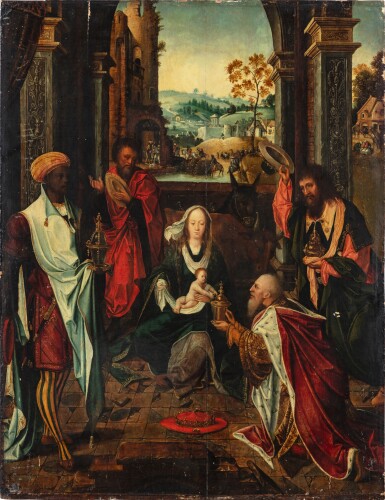
The Adoration of the Magi
Auction Closed
June 11, 01:34 PM GMT
Estimate
50,000 - 70,000 EUR
Lot Details
Description
Studio of Jan de Beer
Antwerp circa 1475 - 1528
The Adoration of the Magi
Oil on panel, unframed
70,1 x 53,5 cm ; 27⅝ by 21 in.
Madame Sipière collection;
Gustave Chaix d’Est-Ange (1800-1876) collection, Paris;
By descent to his son, Gustave Chaix d’Est-Ange II (1863-1923);
His sale, Me Baudoin, Paris, Galerie Charpentier, 11 December 1934, lot 20 (as Antwerp School);
Where acquired and thence by descent to the present owner.
Baron J. du Teil, ‘La collection Chaix d’Est-Ange’, in Les Arts, July 1907, no. 67, p. 5 (repr.) and 12;
M.J. Friedländer, ‘Die Antwerpener Manieristen von 1520’, in Jahrbuch der Preußischen Kunstsammlungen, 1915, vol. 36, p. 78, cat. 25e (as Group C);
D. Ewing, The paintings and drawings of Jan de Beer, Dissertation in the University of Michigan, 1978, vol. 1, p. 174, no. 11;
D. Ewing, Jan de Beer : Gothic renewal in Renaissance Antwerp, Turnhout 2016, p. 184, 306, no. 10.9 (as After Jan de Beer).
This composition reprises the central panel of a triptych that is now lost, whose wings depicted the Flight into Egypt and the Nativity, probably dating to 1518–1519. Originally attributed to Lucas van Leyden, then to Herri Met de Bles and finally to Rogier van der Weyden, Friedländer suggested the name of the Master of the Von Groote Adoration in 1915 and 1933, identifying the prototype as the panel in the Johnson collection, now in Philadelphia (inv. 383); in his opinion it served as the model for the triptych in Munich (Alte Pinakothek, inv. 1431 a-c). In 1978, Dan Ewing proposed that the works in Philadelphia and Munich shared a common prototype, now lost, which could be assigned to the artist Jan de Beer, with the Munich version as the most faithful.
Jan de Beer’s work was one of the first Antwerp compositions to have been widely copied; after this, works by Pieter Coecke van Aelst would follow suit: additional versions were at that time considered to be on a par with the original compositions and seen as a way of disseminating a work to a larger audience and making it accessible to more collectors and churches.
Dan Ewing has identified about fifty copies and variants of the Munich triptych – not an exhaustive list – making a distinction between those that reprise the whole triptych; those that only reproduce the central panel but which were probably originally part of a triptych; and lastly complete triptychs whose wings do not match any of the known compositions. The present Adoration of the Magi faithfully reproduces the Munich composition, with the exception of two shepherds on the extreme right. However,an infrared examination of our panel reveals that these were originally present in the underlying drawing, and were probably covered over in a relatively early restoration.
In 2016 (op. cit., p. 189), Dan Ewing pointed out the careful attention paid to the balance of the composition and the play of diagonals and vanishing lines, in his view reaching a degree of accuracy that the artist would never surpass. Ewing classified the present version as one of the first ten iterations on his list, partly because the design is so faithful to the central panel of the Munich triptych, but also because of the comparability of the details and palette.
The quality of the present Adoration of the Magi must have impressed distinguished collectors over the years. For a long time in the Chaix d’Est-Ange family, our painting featured in an article about the collection in the magazine Les Arts (see bibliography), alongside works by Leonardo da Vinci, Michelangelo, Murillo and Van Dyck.
You May Also Like


