
Property from a Belgian Private Collection
Jan Pauwel Gillemans, called the Younger
Fountain with an Allegory of Victory and a still life
Lot Closed
June 13, 01:25 PM GMT
Estimate
8,000 - 12,000 EUR
We may charge or debit your saved payment method subject to the terms set out in our Conditions of Business for Buyers.
Read more.Lot Details
Description
Jan Pauwel Gillemans, called the Younger
Antwerp 1651 - 1704
Fountain with an Allegory of Victory and a still life
Oil on canvas
105 x 73,5 cm ; 41⅜ by 29 in.
Collection Leo van Puyvelde, Chief Curator of the Royal Museums of Replica Handbags s of Belgium;
By descent to the present owner.
A specialist in still lifes, the Flemish painter Jan Pauwel Gillemans the Younger (1651–1704) was the son of Jan Pauwel Gillemans the Elder, with whom he began his training. He then became a pupil of Joris van Son before being admitted, in 1673 or 1674, as master of the Guild of St Luke in Antwerp and travelling in Europe. Gillemans demonstrated great variety in his still life compositions: flowers, fruits, banquets, pronkstillevens and hunting scenes. Sometimes he incorporated mythological or allegorical themes, in collaboration with painters in his circle, giving his works a greater impact. He enriched his compositions with a vibrant palette and fine detail in his elaborate mises en scène, creating a more idealized and decorative vision of still life.
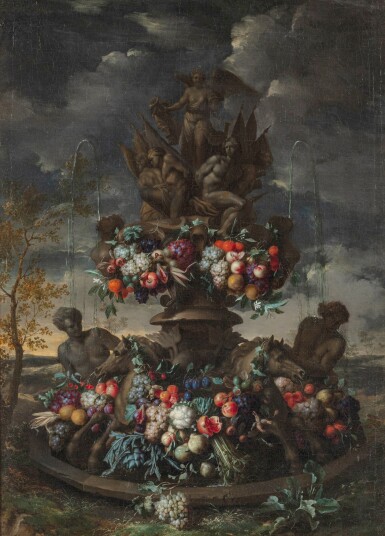
In the present work, Jan Pauwel Gillemans the Younger combines a still life of fruits, vegetables and flowers with the basins of a fountain in a rolling inhabited landscape. It is possible to pick out grapes, oranges, figs, chestnuts, pomegranates, lemons, cherries, peaches, ivy leaves, flowers, apples, pears, artichokes, hazelnuts, cauliflowers, blackberries, plums and ears of corn. Crowning the fountain is an allegory of Victory, holding a trumpet, who seems to be ushering in the light of the rising sun, dispersing the clouds from a still-dark sky. At her feet, prisoners of war in chains are surrounded by standards, evoking military triumph. They rest on a first level of fruits, vegetables and plants, flanked by two female busts from which spurt jets of water.
In the lower register of the fountain, in the second basin filled with vegetal elements extending the still life, there are two hippocamps, with water trickling from their nostrils and mouths. On either side are what could be interpreted as tritons, judging by the way their hair gives the impression of floating. These amassed foodstuffs and plants, together with the allegory of Victory, seem to embody the abundance of a triumphant nation.
In this very theatrical and detailed composition, there are many references to the visual lexicon of antiquity. These can also be found in other compositions by this artist’s hand, such as Garlands of Fruit with Putti (Sotheby’s, Milan, 16 November 2010, lot 64) and Vertumnus and Pomona (Cologne, Lempertz, 16 May 2015, lot 1103). Such references are expressed not only in the hippocamps, the allegory of Victory and the enchained enemies but also in the fruits, vegetables and plants reminiscent of those that spill out of cornucopias.