
Property from a Private Collection
Sir Anthony van Dyck
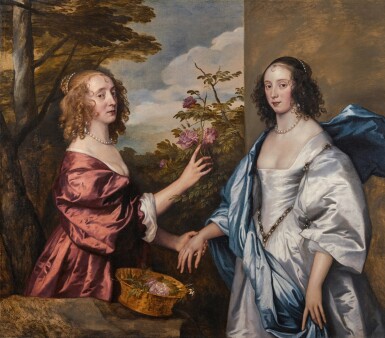
The Cheeke Sisters: Double portrait of Essex, Countess of Manchester (circa 1617–1658) and her sister, Anne, later Countess of Warwick and Clanricarde (1620–after 1683), three-quarter-length, in a landscape
Auction Closed
December 3, 07:54 PM GMT
Estimate
400,000 - 600,000 GBP
Lot Details
Description
Property from a Private Collection
Sir Anthony van Dyck
Antwerp 1599 – 1641 London
The Cheeke Sisters: Double portrait of Essex, Countess of Manchester (circa 1617–1658) and her sister, Anne, later Countess of Warwick and Clanricarde (1620–after 1683), three-quarter-length, in a landscape
oil on canvas
unframed: 127.7 x 149.8 cm.; 51¼ x 59 in.
framed: 162 x 177 cm.; 63¾ x 69¾ in.
Probably the sitters’ cousin, Frances Seymour, Duchess of Somerset (1599–1674), and bequeathed by her to her daughters (listed in her will as ‘a double picture of my Lady Manchester and Mrs Rogers, drawn by Sir Anthony Vandicke’);
Frances, Countess of Southampton (d. 1680/81) and Jane, Baroness Clifford (1637–1679);
Probably Anonymous sale, London, Peacock;
Anonymous sale, London, Christie’s, 5 March 1836, lot 32 (as ‘Portrait of a lady with a young girl, and flowers’) for 3 guineas;
Where acquired by Henry Fowler Broadwood (1811–1893), Lyne Capel, Surrey;
His posthumous sale (‘The Collection of the Late H.F. Broadwood, Esq.’), London, Christie’s, 25 March 1899, lot 42 (as ‘Sir A. Vandyck’ and erroneously described as ‘Portrait of the Countess of Manchester… holding the hand of her daughter Lady Rich’), for 260 guineas. to S.T. Smith;
Frederick O. Sears, Boston;
Arnold Sigurd Kirkeby (1901–1962), Chartwell Mansion, Los Angeles;
By whom gifted to the Los Angeles County Museum of Art, Los Angeles, in 1953 (acc. no. A 6489.53-1);
By whom deaccessioned, Los Angeles, Replica Shoes Parke-Bernet, 7 November 1977, lot 105 (as ‘School of Sir Anthony van Dyck’ and erroneously described as ‘Lady Manchester and Lady Dick’), for $3,250;
Private collection, USA;
Anonymous sale (‘The Property of a Lady’), New York, Christie’s, 23 January 2004, lot 134 (as ‘Studio of Sir Anthony van Dyck’), for $130,700;
Private collection, USA;
With Philip Mould, London;
With Fergus Hall, London;
From whom acquired by the present owner.
San Marino, Huntington Art Gallery, on long term loan, 2013–2018.
H.M.S.O., Bath MSS, vol. IV, London 1968, pp. 371–72;
Z.Z. Filipczak, ‘Reflections on Motifs in Van Dyck’s Portraits’, in A. Wheelock, S. Barnes and J. Held, Van Dyck Paintings, exh. cat., Washington D.C. 1990, p. 63, nn. 38 and 44 (one of the sitter’s misidentified);
Los Angeles County Museum Bulletin of the Art Division, vol. VI, 1954, reproduced p. 11;
E. Larsen, The Paintings of Anthony van Dyck, Luca 1988, vol. II, p. 494, no. A241 (as ‘either studio or a follower’);
O. Millar et al., Van Dyck: A Complete Catalogue of the Paintings, New Haven and London 2004, p. 593, under no. IV. 198 (as one of a number of versions ‘probably devised by the studio’);
T. Page, ‘Cheeke to Cheeke’, in Huntington Verso, posted online, 22 March 2013.
One of only three female double portraits painted by the artist remaining in private hands, this graceful depiction of the Cheeke sisters – Essex, Countess of Manchester, and Anne, later Countess of Warwick – is a striking example of the late work of Sir Anthony van Dyck. It belongs to a distinguished group of ‘Friendship Portraits’, which are particularly characteristic of his English period, and an unprecedented type of such double portraits: those of women. Depicting two sitters within a single painting linked by family, kinship, or office, rather than marriage, was a convention that had been pioneered in Italy by Andrea Mantegna and subsequently refined by artists like Raphael, in such works as his Double Portrait of Andrea Navagero and Agostino Beazzano (Rome, Galleria Doria Pamphilj). At a time when it was widely believed that women were incapable of real friendship, however, this convention was traditionally the preserve of the representation of men. Van Dyck was the first to adopt this idea in the portrayal of women, usually in what can be called 'portraits of occasion'– a visual equivalent to 'poems of occasion'. The artist painted seven such double portraits of women during the roughly eight years he spent in England (the present work included), and in all but one instance that 'occasion' was the impending marriage of one of the sitters. Almost all of these works date to the last years of the artist’s life, from circa 1636 onwards.
An elegy on marriage and love, the portrait is rich in symbolic meaning. On the left the elder of the two sisters, who is already married, glances towards the viewer with a tender but knowing gaze, her finger gesturing to a rosebush, symbolising her knowledge of carnal love. On the right, dressed in virginal white and soon to be wed, her younger sister Anne is presented to the viewer more fully. In gently taking her sister’s hand and guiding it toward a basket of roses, Essex symbolically encourages Anne and shows her she has nothing to fear – the roses have no thorns, and the pleasures of marital love await. The composition shows close formal similarities with the portrait of Katherine, Lady Stanhope, later Countess of Chesterfield, and Lucy, Countess of Huntingdon dated to circa 1636–1638 (fig. 1; Yale Center for British Art, New Haven); with a similar, though reversed interrelation of the figures, and a comparable palette of contrasting ivory and russet-coloured dresses. Van Dyck had already established a reputation as one of the finest portrait painters in Europe when he arrived in London in 1632. The startling body of work he produced in the last decade of his life captured the elegance of the Stuart court in the crucial years before the outbreak of the Civil War and left a lasting legacy on British art that is still felt today.
The sitters were the daughters of Sir Thomas Cheeke (1570–1659) and his second wife, Lady Essex Rich (1585–1658), daughter of Robert Rich, 1st Earl of Warwick (1559–1619). Cheeke enjoyed a prominent career in Parliament during the 1620s, but his influence had begun to wane by the 1630s. He was elected Member of Parliament for Harwich during the Short Parliament in 1640, a seat he retained with the election for the Long Parliament in November of that year. Cheeke’s career was supported by his brother-in-law, Robert Rich, 2nd Earl of Warwick (1587–1658), whose likeness was also captured by Van Dyck in a magnificent full-length portrait, now at the Metropolitan Museum, New York, and both sided with Parliament after the outbreak of the Civil War.
His eldest child from his second marriage, Essex, standing to the left, was first married to Sir Robert Bevill of Chesterton (1572–1634), Sheriff of Huntingdonshire from 1605. Upon his death, she married secondly Edward Montagu, 2nd Earl of Manchester (1602–1671), in December 1642. Manchester was a staunch Parliamentarian and in 1643 was appointed Major-General of the Parliamentary forces in East Anglia, with Oliver Cromwell serving as his second in command. Manchester opposed the trial of King Charles I, however, and later assisted in the Restoration of his son in 1660.
To right, her younger sister Anne was thrice married: firstly, to Richard Rogers (circa 1611–1643), a Royalist soldier and Member of Parliament for Dorset, in about 1637, which helps date this painting. Following his death, in 1645, she married her cousin, Robert Rich, 3rd Earl of Warwick (1611–1659), who was also a supporter of the King during the Civil War (though he never bore arms in favour of the Royalist cause). She married thirdly, as his second wife, Richard Burke, 8th Earl of Clanricarde (1639–1702).
The handling of Van Dyck’s portrait of the Cheeke sisters, with its slightly cooler palette and simplified modelling of forms, is typical of his late English period works. Essex’s light auburn hair is masterfully rendered with a great economy of brushstrokes, utilising the warm reddish-brown ground beneath. The handling of the drapery, especially in her voluminous sleeve, displays remarkable freedom in the application of paint. Such treatment of the drapery can be compared with that in other great late works by the artist, notably the portrait of Sir Thomas Hanmer (Weston Park)1 or the magnificent portrait of the artist’s wife Mary, Lady van Dyck (Museo del Prado, Madrid).2 As Wiliam Sanderson noted in his Graphice, published in 1658, Van Dyck sought to ‘put Ladies dresse into a carless Romance’, dispensing with overly contemporary details of costume and instilling his sitters with a relaxed elegance, and a certain timelessness distinct from the formal attention his slightly older contemporaries had paid to dress and ornament, such as Daniel Mytens or Cornelius Johnson. Indeed, it has been suggested that Van Dyck’s reduction of costume details gave a radical air of informality to his portraits of female sitters, emphasising the inner qualities of the sitter, rather than dwelling on outward material trappings.3
Van Dyck’s later years in London were some of the busiest in his career and saw demand for his portraits continue to grow. Upon his arrival in England, the painter had rapidly established a carefully orchestrated practice to cater for his growing number of clients. With a studio of pupils to assist him, sittings with the painter usually lasted around an hour and patrons would be entertained with the ‘Sweetness’ of Van Dyck’s conversation, including breaks for dinner, hosted by the painter. Typically, a sitter’s pose would be established in a rapid charcoal or white chalk sketch on coloured paper. The head would then be painted onto the canvas during an hour-long sitting, with another appointment arranged if necessary. In this way, Van Dyck was able to work on several pictures simultaneously in an attempt to fulfil the demand for his work. In order to avoid a second sitting, the painter would often rework successful portrait heads into new pictures. Indeed, independent portraits of both these sitters by Van Dyck exist, both at Exton Hall,4 probably painted around the same time as the present work. In the portrait of Anne (fig. 2), while her features are almost identical to those seen here, the sitter’s pose has been adapted to fit the narrative and symbolic requirements of a double portrait, with her right hand extended to meet her sister’s and a blue shawl added for compositional balance. Another three-quarter-length portrait of Anne, formerly at Warwick Castle, painted in Van Dyck’s studio, repeats the pose of the present portrait, again showing her with her arm outstretched. In the independent portrait of Essex, Countess of Manchester, by contrast, the sitter’s pose and tone differ considerably, indicating that the artist probably relied on a fresh sitting for her likeness here. It is a pose that Van Dyck would return to, with small adjustments, on a number of occasions during these later years, however, as seen for example in his Portrait of a Lady in the Statens Museum for Kunst, Copenhagen5 and the Portrait of Mrs Arthur Goodwin in The State Hermitage Museum, St Petersburg,6 both painted circa 1639, within the last two years of Van Dyck’s life.
Prior to the publication of the catalogue raisonné of Van Dyck’s paintings in 2004, this painting was known to scholars only through photographs, having been in a US private collection since the late 1970s. However, its re-emergence at auction in New York that same year, allowed for a thorough re-assessment. In 2005, Sir Oliver Millar was able to study the picture first-hand and noted its ‘good quality’ in unpublished notes, now in the Paul Mellon Centre Archive in London (ONM/2/94). The picture was subsequently cleaned and restored, revealing numerous pentimenti, notably in the alteration of the sitters’ costumes, as well as the quality of the brushwork, particularly in the figure of Essex. First-hand examination after cleaning also enabled both Dr. Malcolm Rogers and Dr. Christopher Brown to endorse the attribution, considering the painting characteristic of Van Dyck’s late English period pictures, when the artist was working with a well-organised studio and within established studio practices. Thus, while certain passages, for example Lady Rich’s draperies, may have been laid in by his assistants, many areas are characterised by a fresh and bold touch, notably both ladies’ heads and the roses, whilst the thinly applied background is entirely characteristic of works of this period.
The early provenance of this painting is, as yet, uncertain. However, it is most likely the painting that belonged to the sitters’ cousin Frances Seymour, Duchess of Somerset and is referred to in her will as being bequeathed to her two daughters (see Provenance). Frances also sat to Van Dyck circa 1636, for a portrait formerly in the collection of the Duke of Northumberland.7 At least two copies of the composition were made in the studio, presumably to supply to other members of the sitters’ families. A version was in the Finch collection at Burley-on-the-Hill;8 and another was formerly at Kimbolton Castle, in the collection of the Earls of Manchester.
1 Inv. no. 101.0090, oil on canvas, 107.5 x 85.5 cm.
2 Inv. no. P001495, oil on canvas, 104 x 81 cm.
3 K. Hearn (ed.), Van Dyck & Britain, exh. cat., London 2009, p. 87.
4 Millar 2004, nos. IV.60 and IV.198.
5 Millar 2004, no. IV.255.
6 Millar 2004, no. IV.106.
7 Oil on canvas, 120.5 x 96.5 cm. Sold in these rooms, 9 July 2014, lot 18.
8 Sold Vienna, Dorotheum, 21 April 2010, lot 28.
You May Also Like


