
Laurence Stephen Lowry, R.A.
A Group of Seven
Auction Closed
November 26, 03:10 PM GTNN
Estimate
80,000 - 120,000 GBP
Lot Details
Description
Laurence Stephen Lowry, R.A.
1887 - 1976
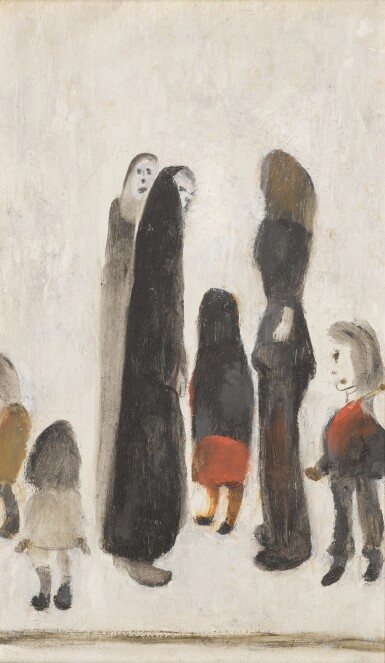
A Group of Seven
oil on board
unframed: 29.5 by 18.5cm.; 11½ by 7¼in.
framed: 45 by 36.5cm.; 17¾ by 14¼in.
Executed circa 1965.
We are grateful to Richard Grossick for his kind assistance with the cataloguing for the present work.
The Estate of L.S. Lowry, bequeathed to Carol Ann Lowry
Crane Kalman Gallery, London, where acquired by the family of the present owner, December 2012, and thence by descent
On long-term loan to The Lowry until 2012
London, Crane Kalman Gallery, The Estate of L.S. Lowry: A Selection of Works, December 2012
Crane Kalman Gallery, London, Modern British Art, 17th March - 20th March 2022, unnumbered (titled Group of Seven)
Crane Kalman Gallery, London, A 70th Anniversary Exhibition, 21st October - 10th December 2022 (titled Figures Talking)
London, Crane Kalman Gallery, A 70th Anniversary Exhibition, L. S. Lowry R.A. no. 36, p.70, illustrated p.71
“My characters? They are all people you might see in a park. They are real people, sad people; something’s gone wrong in their lives. I’m very attracted to sadness, and there are some very sad things you see.”
L.S. Lowry, quoted in Lowry, A Visionary Artist, p. 162
By the mid-1960s, L. S. Lowry’s art gradually became more introspective and moved away from the depiction of large industrial and crowded scenes. He distanced himself from the crowded rhythms of urban life to almost abstract studies of individual figures. By removing any extraneous background, he forces the viewer to focus on individuals, distilling humanity to its most essential forms.
A Group of Seven belongs to this later period, depicting a small cluster of figures against a white background. His sparing use of paint in muted tones transforms the figures into shadows, appearing both together as a group and apart as individuals, highlighting their physical proximity and mental distance. They evoke an uneasy community–a meeting of strangers rather than a social group. The sense of community that fuelled Lowry’s urban vistas has now been replaced in the present work by an isolated grouping, reflecting Lowry’s deepening fascination with character and condition.
The faces—mask-like and pale—reveal little personal emotion and the repetition of stance and contour suggests the “doubles” that also recur in his late oeuvre, echoing the artist’s own sense of solitude. Lowry himself admitted, “There’s a grotesque streak in me and I can’t help it… They are real people, sad people; something’s gone wrong in their lives.” This tenderness towards human frailty runs through this intimate but affecting work.
Stripped of a surrounding environment, A Group of Seven becomes an existential study—an outward expression of Lowry’s private world. Its minimalism and melancholy encapsulate his late vision: an art at once grotesque and humane, distilled to a few strokes yet charged with enduring compassion.
“Even though Lowry’s late works are very different from those of the middle and early years, it is still possible to see how the whole is a body of work, produced by one individual. Lowry’s styles are personal, eccentric and visionary.”
Lindsay Brooks in Lowry’s People, p. 3
You May Also Like


