
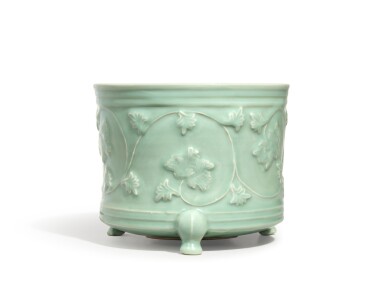
A rare and large heirloom Longquan celadon 'peony' tripod incense burner, Southern Song - Yuan dynasty | 南宋至元 龍泉青釉貼花纏枝牡丹紋奩式爐
Auction Closed
September 9, 11:30 AM GMT
Estimate
2,000,000 - 3,000,000 HKD
Lot Details
Description
of impressive size, superbly potted with a broad cylindrical body rising from three cabriole legs to a flat inturned rim, the exterior applied with six sprig-moulded peony blossoms borne on a slip-trailed meandering stem, framed within double-line borders, covered overall save for the footring with a lustrous sea-green kinuta glaze, the glaze pooling in the recesses to accentuate the relief decoration, Japanese double wood box and silver metal cover
w. 22.5 cm
Collection of the Date family, by repute.
Mayuyama & Co., Ltd, Tokyo.
Porcelaine. Chefs-d'œuvre de la Collection Ise, Musée Guimet, Paris, 2017, cat. no. 26.
Ise Korekushon Sekai wo Miryoshita Chugokutoji / The Enchanting Chinese Ceramics from the Ise Collection, Museum of Oriental Ceramics, Osaka, 2017, cat. no. 32.
It is exceptionally rare to find an incense burner of this lian form moulded with peony scrolls, especially one distinguished by such commanding presence and a lustrous kinuta glaze.
The only other known heirloom example of comparable calibre is preserved at the Banna-ji Temple in Ashikaga; it is designated as an Important Cultural Property of Japan (accession no. 00025).
Robed in an unctuous yet vibrant sea-blue glaze, the present incense burner is an extraordinary example of a much-loved Longquan design. Produced at the height of celadon production in the 13th century, the incense burner possesses all the features most desirable for a piece of this type, sturdily potted yet gracefully poised atop three feet, adorned with crisp floral moulding coated in a dazzling thick glaze.
Known to Japanese connoisseurs as kinuta (‘mallet’), after its more common appearance on vases of a ‘mallet’ shape, this thick and luminous blue-green glaze effect has long been coveted by collectors and appears only on the highest quality of Longquan ceramics, likely produced with the support of imperial patronage; see Suzanne G. Valenstein, A Handbook of Chinese Ceramics, New York, 1989, pp. 100-101.
來源
傳伊達家族收藏
繭山龍泉堂,東京
展覽
《Porcelaine. Chefs-d'œuvre de la Collection Ise》,吉美博物館,巴黎,2017年,編號26
《イセコレクション―世界を魅了した中国陶磁》,大阪市立東洋陶瓷美術館,大阪,2017年,編號32
奩式,內折口,口沿及底圈分別飾兩道弦紋,直腹略收,外壁貼花連枝牡丹紋,平底下承三足,通施青釉,釉色粉青厚潤,整體敦厚穩重。
如此以牡丹紋裝飾之奩式爐本屬難得,且尺寸碩巨,並施以砧青厚釉者更屬罕見。堪與之比擬者,傳世僅一,並於日本被列為重要文化財(登錄編號:00025),貯於栃木縣鑁阿寺。
此爐通體施青釉,釉色瑩潤厚實,光華奪目,造型優雅,乃龍泉窰中難得一見之佳作。燒製於十三世紀龍泉青瓷鼎盛之際,其器形端莊敦厚,三足鼎立尤見嫻雅,爐身飾貼塑牡丹紋,紋飾清麗生動,釉層濃厚瑩澈,殊為珍貴。
此類釉色為日本鑑賞家所稱之「砧青」(kinuta),以常見於砧式瓶(形如木槌之瓶式)而得名。此種濃厚瑩亮之藍綠釉彩歷來為藏家所珍愛,僅見於最上乘之龍泉青瓷,多認為與當時南宋宮廷之支持密切相關;詳見 Suzanne G. Valenstein 著《A Handbook of Chinese Ceramics》,紐約,1989年,頁100-101。
You May Also Like


