
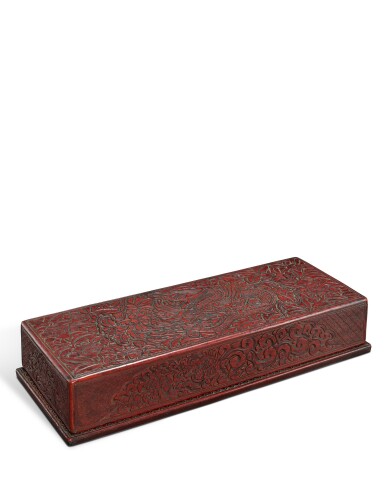
A rare and important large carved cinnabar lacquer ‘dragon’ sutra box and cover, Southern Song dynasty | 南宋 剔紅應龍花卉紋大長方經盒
Auction Closed
May 7, 10:26 AM GMT
Estimate
1,500,000 - 3,000,000 HKD
Lot Details
Description
Japanese wood box
overall 52.1 by 20.2 by h. 9.1 cm
An old Japanese private collection, by repute.
With winged dragons swirling amongst a lush world of peonies, the present box is a rare and extraordinary example from the golden age of lacquer arts. Crisply rendered yet smooth to the touch; imposing and grand yet understated and serene – this sutra box represents one of the finest examples of Song dynasty lacquerware to have come to market in recent years.
Unlike the sharper heavily polished wares of the Yuan, Ming and Qing dynasties, Song lacquer wares possess a serene softness unmatched in the ensuing centuries. Produced using the later ubiquitous diaoqi (carved lacquer) technique, this box was painstakingly carved in a simple yet bold manner with remarkable three-dimensionality achieved with just the recession of the background. While later examples of diaoqi are often more complex, florid, and multi-demensional, the beauty of Song lacquer and the present box lies precisely in its restrained design philosophy, understated finish, and extraordinary attention to detail.
The present craftsmanship is not only remarkable in its quality but also in its subject matter. With forked tails and exuberant feathery wings, the yinglong (‘responsive dragon’) is often considered the oldest dragon in the Chinese canon and particularly auspicious a source of life-giving rain. Unlike many more typical wingless depictions, these yinglong possess an extraordinary sense of vitality and movement, flouncing atop the vermillion ground among an almost fantastical floral scene. Winged dragons of this type are attested, though rare, in many Song dynasty media and continued to be represented in the ensuing millennia. Compare related depictions of yinglong in a Song dynasty stone carving of beasts from the Classic of Mountains and Seas (Shanhaijing) preserved in the Chuzu Temple, Shaolin Monastery, Zhengzhou; and a later example adorning a Yongle period jar sold in these rooms, 16th May 1989, lot 112, illustrated in Sotheby’s. Thirty Years in Hong Kong, Hong Kong, 2003, no. 211.
Sutra boxes of this type were first produced around the early Northern Song period as a way to protect and glorify Buddhist texts in temple and palace contexts. Glowing in a deep vermillion red and adorned with auspicious symbolism and vibrant designs, these boxes represent the ultimate companion to the texts they once held as symbols of status, religious devotion and wealth. Compare a famous early group of sutra boxes and reliquaries excavated from a Song dynasty site – but likely produced even earlier – at the Pagoda of Huiguang, in Rui’an, Zhejiang province, in Harry Garner, Chinese Lacquer, London, 1979, pl. 24. These boxes, decorated with Buddhist scenes in a still emergent style, would soon be followed by similar examples in every successive period as master craftsmen sought to display their creativity and skill in service of sanctifying the scriptures. Compare a lacquer sutra box of similar form from the Yongle period adorned with dragons and clouds and two sutra covers in the Metropolitan Museum of Art, New York, included as examples of Buddhist devotional art in Recasting the Past. The Art of Chinese Bronzes, 1100-1900, Metropolitan Museum of Art, New York, 2025, cat. nos 76 and 77.
To date, no other Song dynasty sutra box of this extraordinary design, size and quality appears to survive. For other examples of Song lacquer wares carved in this sumptuous style, compare a closely related tray carved with a pair of yinglong among flora from the Kamakura National Treasure Museum, included in the exhibition Sō Gen no bi/ The Colors and Forms of Song and Yuan China, Nezu Institute of Replica Handbags s, Tokyo, 2004, cat. no. 93; a thirteenth century sutra box carved with a pair of phoenixes in the Linden Museum, Stuttgart, illustrated by Yasuhiro Nishioka in ‘Chinese Song dynasty carved lacquer’, Forbidden City, March 2012, pp 34-49, pl. 5; and a related box of similar phoenix design in the Tokyo National Museum, illustrated ibid., pl. 14 also included in He Zhenji, ed., Ti cai liu bian / Lacquer Art of Song Dynasty, Hangzhou, 2022, fig. 2.4.
來源
傳日本私人舊藏
此盒雕飾飛龍穿翔於盛放牡丹間,華麗而生動,雕工細膩明朗,氣勢莊嚴宏偉,卻予人含蓄靜穆之感,當屬近年市場所見宋代漆器之翹楚。
宋代漆器之韻味,迥異於元、明、清諸朝作品之鋒利濃艷,別有一種和緩柔美的氣息。此盒雖使用後世廣泛流行之雕漆技術製作,卻以樸拙簡約刀法精心雕琢,僅憑背景之深刻凹陷,即達非凡深邃立體之感。後世雕漆雖趨於繁複華麗,多層次交錯盤旋,然宋人漆藝之妙,正在於設計簡約內斂,工藝精湛嚴謹,盡顯宋代美學之卓然境界。
此盒不獨工藝精巧絕倫,主題紋飾亦殊為奇特。盒上所刻飛龍,尾作叉分,雙翼羽翅豐盈,此即中國古籍中所載「應龍」,乃龍類中最古老且祥瑞者,傳可致甘霖,潤萬物生機。盒面應龍造型活潑靈動,騰躍於朱紅漆地之上,流連於奇花異卉之間,生氣勃發,姿態妙絕。宋代所製帶翼之應龍紋飾殊為難得,然亦見於宋代其他諸多藝術媒材,且後世亦延續不絕。如河南鄭州少林寺初祖庵所藏宋代《山海經》石雕異獸圖中,即可見相類應龍紋飾;另見一明永樂朝青花罐上所飾飛龍紋,1989年5月16日曾於香港蘇富比拍賣,載於《蘇富比香港三十週年》圖錄,香港,2003年,編號211。
此類經盒,最早約出現於北宋初年,原用以保護並莊嚴佛家經典,常置於寺廟或宮廷之中。盒身髹以朱紅,雕飾祥瑞紋樣,色澤流麗華美,實乃當時盛載佛經之最佳良伴,彰示地位、財富與虔誠之象徵。可比較浙江瑞安慧光塔宋代遺址出土一批著名經函與舍利函,盒面飾佛教紋樣,圖載於迦納爵士所著《Chinese Lacquer》一書,倫敦,1979年,圖版24 。此批早期經函雕飾佛教場景,風格尚質樸簡潔,然其後各朝代之工匠,競相以技藝創意供奉經典,雕製類似經盒。另可參考紐約大都會藝術博物館所藏永樂朝雕龍紋漆經函一例,及兩件經夾封面,著錄於《Recasting the Past. The Art of Chinese Bronzes, 1100-1900》,紐約,2025年,圖錄編號76、77。
迄今宋代類似體量、紋飾與品質相若之經盒,尚無第二例傳世。欲參考其他雕漆風格類似之宋代佳例,可見日本鎌倉國寶館藏一宋代雕漆托盤,上飾雙應龍穿行花卉之間,曾展於《宋元の美》展,根津美術館,東京,2004年,圖錄編號93;另見德國斯圖加特林登博物館藏十三世紀雕漆雙鳳紋經盒,載於西岡康宏「中國宋代雕漆」,刊於《紫禁城》期刊,2012年3月號,頁34-49,圖版5;東京國立博物館亦藏一相似之鳳紋盒,同著錄於前文,圖版14,並刊於何振紀主編《剔彩流變:宋代漆器藝術》,杭州,2022年,圖2.4。