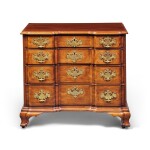

The Clark Family Chippendale Block-Front Chest of Drawers, Possibly by John Carlisle, Jr. (1727–1796), Providence, Rhode Island, Circa 1775
Auction Closed
January 20, 04:11 PM GMT
Estimate
50,000 - 100,000 USD
Lot Details
Description
Figured mahogany
Appears to retain its original oversized cast-brass hardware
Height 33 ¼ in. by Width 37 ¾ in. by Depth 21 in.
Probably originally owned by John Innes Clark (1745-1808) and his wife, Lydia Bowen (1752-1830), of Providence, who m. on September 26, 1773;
To her daughter Harriet Clark (1782-1869), who m. Dr. Robert Hare (1781-1858) on September 9, 1811, of Philadelphia;
To her daughter Lydia Hare (1815-1883), who m. Frederick Prime (1807-1887), New Rochelle, New York;
To her daughter Emily Prime (1842-1909), who m. Lewis Livingston Delafield (1834-1883), New York, New York;
To her daughter Emily Prime Delafield (1870-1961), who m. Dr. Rolfe Floyd (1873-1932), New York, New York;
To her daughter Emily Delafield Floyd (1905-1994) m. Arthur Zimmermann Gardiner (1901-1975), McLean, Virginia;
Thence by decent in the Gardiner family to the present owner.
Retaining its original elaborate oversize cast brass hardware, this blockfront chest of drawers has a history of descent in the Clark family of Providence, Rhode Island. Descendants have traced its ownership to Harriet Clark (1782-1869), who was born in Providence and married Dr. Robert Hare (1781-1858) of Philadelphia on September 9, 1811. He was a Professor of Chemistry at the University of Pennsylvania from 1819-1847 and thereafter a Professor Emeritus. She likely inherited the chest from her parents, John Innes Clark (1745-1808), a prominent Providence merchant, and Lydia (Bowen) Clark (1752-1830), daughter of Dr. Ephraim (1716-1812) and Lydia (Mawney) Bowen (1723-1801). The Clarks may have ordered this chest on the occasion of their marriage on September 26, 1773. At his death in 1808, John Clark bequeathed his wife “the homestead mansion house in Providence, together with all the Furniture, … therein.”1 This chest may correspond to the “1 Swell’d front Small Mahog. Bureau” valued at $10 in the “Furniture in the Dwelling House” of his estate inventory, dated October 11, 1808.”2 The chest has descended through successive generations along female lines through the Hare, Prime, Delafield, Floyd and Gardiner branches of the Clark family for approximately 250 years until the present time.
The Clark family chest appears to stem from the same shop as the block-and-shell desk and bookcase at the Rhode Island Historical Society made for Joseph Brown (1733-1785) shortly after his marriage to Elizabeth Powers in 1750.3 Both the Clark chest and Brown desk and bookcase retain the same pattern of their original cast brass hardware. The Corlis-Bowen block-and-shell desk and bookcase offered in this sale represents the same shop tradition. It was originally owned by Dr. William Bowen (1747-1832) and his wife Sarah Corlis Bowen (1748-1825) of Providence. William Bowen is the brother of Lydia Bowen Clark, the owner of the block front chest offered here, as well as a neighbor of Joseph Brown. William Bowen was also a friend of John Carlile, Sr. (1727-1796), the Providence cabinetmaker to whom this group of chests is attributed. John Carlile Sr. leased land for a new shop along the Providence River, near the houses of William Bowen and Joseph Brown by 1784. In 1795, William Bowen witnessed John Sr.’s will.
The Clark chest, Brown desk and bookcase and Corlis-Bowen desk and bookcase are made of finely-grained mahogany and display shared details such as the block front façade, lipped drawer fronts, cyma bracket feet with a distinctive torus drop, and complex moldings. Similar base moldings and feet are exhibited on a desk in a private collection inscribed “Providence August 6th 1785 / John Carlile junr of / said town / Joyner”.4 The case pieces all share similar drawer construction in the dovetailing of the drawer sides to the front and kerf marks on the inside of the drawer façade, drawer sides that are consistently shorter than the fronts, and “X” markings on the back similar to those on the signed Carlile desk. Many of these techniques correspond to cabinet practice in Boston, where John Sr. learned his trade and where block front furniture was very popular. Other blockfront case pieces from the same shop include a chest-on-chest possibly made for John Brown (1736-1803) and a chest -on-chest at Winterthur Museum possibly owned by Joseph Brown’s daughter, Eliza Ward and her husband Richard Ward (1765-1800) of New York.5
Sotheby’s would like to thank Jennifer Galpern from The Reference Staff at the Rhode Island Historical Society for her assistance with this lot.
1 John Innes Clark Will (1808), Case #A3919, Providence City Hall, Copy in the Collection of the Rhode Island Historical Society.
2 John Innes Clark Inventory, dated October 11, 1808, Providence, Rhode Island Wills, Volume 10 – 1805-1811, pp. 333-359.
4 See ibid, fig. 4, p. 166.
5 See ibid, figs. 2 and 3, pp. 164-165.
You May Also Like


