
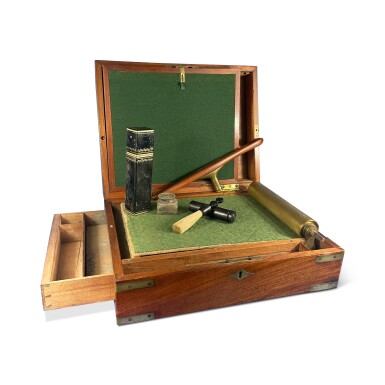
Watt, James; and Company | The first portable copying machine
Lot Closed
June 28, 07:23 PM GMT
Estimate
8,000 - 12,000 USD
Lot Details
Description
Watt, James, and Company
[Portable Copying Press]. United Kingdom: ca. 1800
Mahogany box with brass edges, brass inlaid corner straps and brass handles, interior lined with green felt, metal-coated side damping drawer, original brass rollers, brass and wooden turning screw, pasteboard and cloth folder, as well as the original glass ink well, ink bottle within painted tin holder, two sealed packets of dried ink, and several original sheets of copying paper.
The first portable copying machine: a remarkably complete example with original supplies intact.
On 14 February 1780, James Watt, the famous inventor of the steam engine, was granted a patent for his first duplicating machine. His invention was a result of his own frustration with the time-consuming task of hand-copying his business correspondence with his partners concerning the steam engine. His invention of the portable press solved this problem by offsetting a written document by pressure onto thin, translucent, unsized paper to produce a reversed copy.
The process worked as follows: the original document was written using specially prepared ink and placed within the pasteboard and cloth folder with a sheet—or multiple sheets—of thin, moistened paper. The entire folder was then passed through two brass rollers by turning the screw and the resulting pressure transferred an impression of the ink from the original onto the thin paper. The copy, with the writing impressed in the reverse, could be read through the thin paper.
The portable case opens on hinges, and its upper section contains a collapsible writing pad for preparing the documents. Underneath the writing pad are compartments for writing instruments and paper. An inset compartment in the front of the box holds the turn for cranking the rollers. A special side-drawer contains the metal-coated damping box, which was used for treating and storing the copying paper, with compartments for the storage of ink and other supplies.
Production began in 1780, and continued into the 19th century, when copiers of various sizes were produced (i.e. for quarto, foolscap—like the present—and folio paper). Watt's copier was enormously successful and found users on both sides of the Atlantic, with George Washington, Benjamin Franklin, and Thomas Jefferson as early adopters.
REFERENCE:
Bedini,Thomas Jefferson and His Copying Machines (Charlottesville: University of Virginia Press, 1984); Hills, R. "James Watt and His Copying Machines" in Proceedings of the British Association of Paper Historians 4th Annual Conference, 1993; Rhodes and Streeter, Before Photocopying. The Art and History of Mechanical Copying, 1780-1793, 1999, 8-11; Schils, R. How James Watt Invented the Copier: Forgotten Inventions of Our Great Scientists, 2011, 39-42; Uglow, J. The Lunar Men, 2002, 306-7


