
Property of a New York Collector
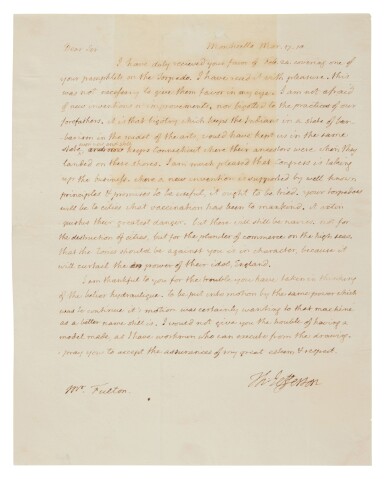
Jefferson, Thomas | Autograph letter signed, praising the spirit of innovation
Lot Closed
June 28, 04:50 PM GMT
Estimate
14,000 - 18,000 USD
Lot Details
Description
Jefferson, Thomas
Autograph letter signed ("Th: Jefferson"), to Robert Fulton, applauding Fulton's innovative work on the torpedo and hydraulic ram
One page (247 x 196 mm mm) on a leaf of wove paper (watermarked dove and olive branch), Monticello 17 March 1810; light offsetting to verso and to a small square area of recto, lower left corner renewed. Accompanied by the autograph address panel (82 x 127 mm) cut from the integral blank, with franking signature of Jefferson ("free | Th: Jefferson").
"I am not afraid of new inventions or improvements, nor bigotted to the practices of our forefathers": Jefferson encourages Fulton's continued work on the torpedo, which he had first developed more than a decade earlier while in Paris.
Robert Fulton, the Pennsylvania-born engineer and inventor, spent two decades in England and France where he began his groundbreaking work on canals, aqueducts, submarines, and steamboats. Returning to the United States in 1806, Fulton renewed his research on torpedoes, which he believed could be used to not only secure harbors and ports from blockade and maritime attack, but also to effectively render navies impotent. He first corresponded with Jefferson about this scheme when the latter was still president, and he continued to seek Jefferson's support after Madison had succeeded to the White House.
On 24 February 1810 Fulton sent Jefferson copies of his two recent publications, Torpedo War, and Submarine Explosions (New York, 1810) and Concluding Address of Mr. Fulton’s Lecture on the Mechanism, Practice and Effects of Torpedoes (Washington, D.C., 1810), together with a letter reporting that the Senate and the Secretary of the Navy had shown interest in the torpedo. This positive reception prompted Fulton to seek Jefferson's "Influence on the side of the arts" because "All the Tories and Marine or navy men are against me, they are even outragious, for if I succeed their hopes of Navies, armies and power with all the frippery will be blown up. … "
Fulton abruptly changes the topic to hydraulic rams ("I have long since made the drawings for your Belier hydraulic but I wished to do more than make a drawing, I wished to send you a working model …), but closes with the request that Jefferson let him know "whether my publication has had any tendency to increase your faith in the practicability and utility of torpedoes—"
In the present letter, Jefferson replied in the affirmative less than a month later, although he was skeptical—despite what Hutcheon terms his "well-known aversion to large and expensive navies"—of Fulton's claim that torpedoes would make navies obsolete : "I have duly recieved your favor of Feb. 24. covering one of your pamphlets on the Torpedo. I have read it with pleasure. this was not necessary to give them favor in my eye. I am not afraid of new inventions or improvements, nor bigotted to the practices of our forefathers. it is that bigotry which keeps the Indians in a state of barbarism in the midst of the arts, would have kept us in the same state even now, and still keeps Connecticut where their ancestors were when they landed on these shores. I am much pleased that Congress is taking up the business. where a new invention is supported by well known principles & promises to be useful, it ought to be tried. your torpedoes will be to cities what vaccination has been to mankind. it extinguishes their greatest danger. but there will still be navies. not for the destruction of cities, but for the plunder of commerce on the high seas. that the tories should be against you is in character, because it will curtail the power of their idol, England."
A gifted inventor himself, Jefferson had also corresponded with Fulton about bélier hydraulique—a hydropowered cyclic water pump designed to pump water to a destination higher in elevation than its source. Jefferson and, later, Madison were contemplating the installation of such a hydraulic ram and the White House, and Jefferson was evidently considering one for Monticello as well. He answered Fulton: "I am thankful to you for the trouble you have taken in thinking of the belier hydraulique. to be put into motion by the same power which was to continue it’s motion was certainly wanting to that machine, as a better name still is. I would not give you the trouble of having a model made, as I have workmen who can execute from the drawing."
Fulton's torpedoes were not self-propelled; they were in essence floating mines that could be triggered either by a timer or by contact with the target ship. While Fulton is best remembered today for his practical development of the steamboat, in 1807, following the maiden voyage of the North River Steam Boat up the Hudson River, he wrote to Joel Barlow that despite the great revolutions in commerce and travel promised by the steamboat, he did not consider that invention even "half so important as the torpedo system of defence and attack; for out of this will grow the liberty of the seas; an object of infinite importance to the welfare of America and every civilized country." Despite congressional appropriations for testing Fulton's torpedoes, the Navy remained resistant to the system during his lifetime.
A fine letter, linking two of the greatest American inventors of the nascent republic, who had in common a keen intellectual curiosity, an optimistic confidence in the future, and an ardent spirit of innovation.
REFERENCE:
The Papers of Thomas Jefferson, Retirement Series, ed. Looney, 2:301, 250–251 (for Fulton's letter); cf. Wallace S. Hutcheon Jr., Robert Fulton: Pioneer of Undersea Warfare (Annapolis: Naval Institute Press, 1981)
PROVENANCE:
Julia M. Dickinson Tayloe, by descent to — Cabell Gwathmey (Parke-Bernet, 9 January 1951, lot 72) — Christie's New York, 3 December 2007, lot 143 (undesignated consignor)


