
Property from the Hohler Collection
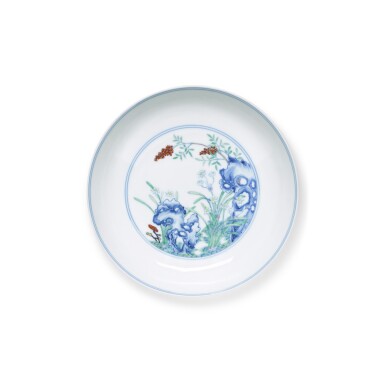
A fine doucai 'narcissus' dish, Mark and period of Yongzheng
Auction Closed
November 6, 03:25 PM GMT
Estimate
40,000 - 60,000 GBP
Lot Details
Description
the base with a six-character in underglaze blue within a double circle
Diameter 20.9 cm, 8¼ in.
Collection of Sir Thomas Beaumont Hohler (1871-1946), and thence by descent.
Exquisitely painted with a rich palette of overglaze enamels and underglaze blue intertwining in an elegant and harmonious design, this dish represents the zenith of Qing dynasty doucai production. The design, which combines flowers, garden rocks and the magical lingzhi fungus, is known to represent a blessing of longevity. The lingzhi, which emerges from dead wood but never rots itself, was considered as a sort of immortal and, when depicted in this arrangement with narcissuses (shuixian or 'water immortals' in Chinese) and rockwork (shoushi or ‘longevity rocks’), has been interpreted as a rebus for the phrase ‘May the Fungus Immortal bestow birthday greetings’ or ‘May the Fungus Immortal grant you long life’ (zhixian zhushou).
Compare a closely related dish, included in the exhibitionThe Hundred Flowers: Botanical Motifs in Chinese Art, Asian Art Museum, San Francisco, 1985, cat. no. 46; another from the Chang Foundation, illustrated in Selected Chinese Ceramics from Han to Qing Dynasties, Taipei, 1990, pl. 137; a third from the Meiyintang Collection, published in Regina Krahl, Chinese Ceramics from the Meiyintang Collection, London, 1994, vol. II, pl. 765; and another in the Toguri Museum of Art, Tokyo, illustrated in Nakazawa Fujio, ‘Chinese Ceramics in the Toguri Museum of Art’, Orientations, April 1988, p. 53, fig. 19. See also a similar dish from the collection of the British Rail Pension Fund, sold in our Hong Kong rooms, 16th May 1989, lot 69 and again, 1st November 1999, lot 364.
You May Also Like


