
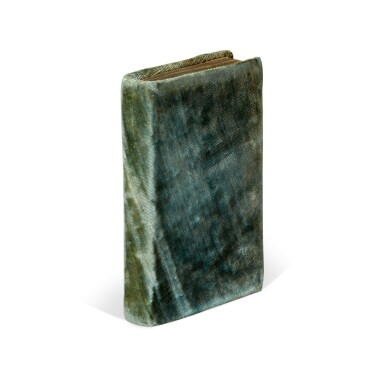
Taurellus, Emblemata physico-ethica, Nuremberg, 1595, blue velvet, used as an album amicorum, Beckford copy
Auction Closed
July 9, 02:57 PM GMT
Estimate
5,000 - 7,000 GBP
Lot Details
Description
Taurellus, Nicolaus. Emblemata physico-ethica, hoc est, naturae morum moderatricis picta praecepta, à Nicolao Tavrello Montbelgardensi, physices & medic. in Altdorfens. Noric. Academia Professore observata, & vario conscripta carmine. Nuremberg: Paul Kauffmann, 1595 [bound with:]
Carmina Funebria quae magnorum aliquot clarorumque virorum felici memoriae dicavit. Nuremberg: typis Gerlachianis (heirs of Katharina Gerlach), 1592
The first edition of a collection of civic emblems intended for use as an album amicorum, a presentation copy from the author to "Ge. Geringero Palatino apud Neagoraeos" (from Neumarkt in the Upper Palatinate). Taurellus (1547-1606) was then professor of natural philosophy and medicine (and sometime Rector) at the Lutheran Altdorf Academy, the university of the city of Nuremberg. His book was financed by a group of Nuremberg burghers, each identified by name and coat of arms, and the work therefore has the appearance of a collection of imprese.
The academic album amicorum, or Gelehrtenstammbuch, a small, printed book interleaved with blank paper for autograph inscriptions, had evolved in the late 1540s at Wittenberg, and quickly spread to other centres of learning. To obviate interleaving, publishers eventually began producing books with pages purposefully left blank (or as here, with a decorative border only), where friends of the owner could write a salutation, their name, and the date. A dozen copies of Taurellus’s book containing such autograph entries are recorded by the Repertorium Album Amicorum (online). One of these, a copy of the 1602 second edition, owned by Andreas Gammersfelder von Solar (1589-1616), contains an entry by Taurellus himself.
The recipient of the copy most probably was the Georg Göringer (Geringer), a court clerk in Neumarkt in the years 1593-1605. By 1605, the book had passed into the possession of Johann Georg Göringer, presumably a relative. He wrote on an endpaper "Liber a me Joh G Gering" and below "Finis studiosum nostrorum sit." The younger man finally put the book to its intended purpose. Twenty-four of his friends and acquaintances contributed entries, in Latin or Greek, all dated between 1605 and 1607, with many indicating Heidelberg as the place of subscription. No Georg Göringer (Geringer) appears in the Heidelberg register of matriculations (edited by Gustav Töpke, 1884-1889), however some of the autographs can be linked to students or dons. They include Georg Sommer and Gebhard Agricola, both from Neumarkt (matriculating respectively in 1602, 1605), the distinguished jurist Denys Godefroy de Guignecourt (professor and rector in 1607) and Wolfgang Lossius (regent of the Contubernium, professor).
Bound at the end is Taurellus'
Carmina Funebria, a series of euologistic verses about notable contemporaries, including Andras Dudith and Thomas Erastus, concluding with verses about the author's own eight children who died in childhood.
8vo (161 x 98 mm). Italic type. collation: a-b8 A-M8 (without E2, cancelled as usual): 111 leaves; a8: 8 leaves. i) Title-page within woodcut border, woodcut initials and headpieces, 83 (of 84?) woodcut emblems, each with a blank verso with typographical border only, 24 manuscript inscriptions. (Some dampstaining, marginal foxing, D6 creased). ii) title page within typographical border, woodcut device to title, woodcut initials and headpiece.
binding: Later (probably early nineteenth-century) blue velvet over pasteboards (166 x 106 mm), blue edges.
provenance: G. Göringer (Geringer), of Neumarkt, Upper Palatinate — Johann Georg Göringer — William Beckford (1759-1844) — [inherited by] Alexander Douglas Hamilton, 10th Duke of Hamilton (1787-1852), Hamilton Palace sale, Replica Shoes 's, 2 July 1883, lot 2440, £4-15 to H. Stevens — John William Beaumont Pease, 1st Baron Wardington (1869-1950), armorial bookplate and note "From the Hamilton Palace sale" — Lord Wardington (1924-2005), bookplate on lower pastedown — Marlborough Rare Books, sold in 1981 to — Arthur and Charlotte Vershbow, sale, Christie's New York, 20 June 2013, lot 712. acquisition: Purchased at the preceding sale. references: VD16 T 249 & T 247; Landwehr, German Emblem Books 586


