
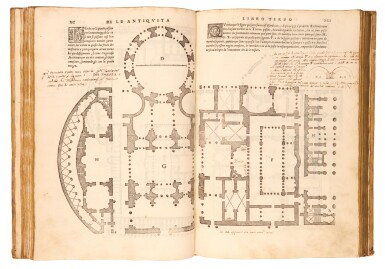
Serlio, Il terzo libro; Regole generali, Venice, 1540, later vellum, Conyers copy
Auction Closed
July 9, 02:57 PM GMT
Estimate
4,000 - 6,000 GBP
Lot Details
Description
Sebastiano Serlio. Il terzo libro di Sabastiano Serlio bolognese, nel qual si figurano, e descrivono le antiquità di Roma, e le altre che sono in Italia, e fuori d'Italia. (Venice: Francesco Marcolini, March 1540) [bound with:]
Regole generali di architettura di Sebastiano Serlio bolognese sopra le cinque maniere de gli edifici, cioè thoscano, dorico, ionico, corinthio, e composito. Con gli essempi de l'antiquita, che per la maggior parte concordano con la dottrina di Vitruvio... Con nuove additioni. Venice: Francesco Marcolini, (February) 1540 [1541]
First edition of Il terzo libro, second edition of Regole generali. It is quite likely that the two were issued together as they are often bound together, as here.
In addition to extensive marginal annotations in an elegant humanist hand, this volume bears a presentation inscription from Sir Roger Newdigate (1719-1806) to his brother-in-law John Conyers ("Given to John Conyers by Sir Roger Newdigate Baronet | August 8th 1755 at Arbury Warwickshire"), as well as the bookplate "John Conyers Esq. | Copt Hall | Essex". At the time of this ownership inscription, both men were busy rebuilding their dilapidated Elizabethan estates, and although Newdigate had a hand in both projects, the ambitions for Copt Hall and Arbury Hall were very different. Newdigate's designs for his brother-in-law's house embraced fashionable Palladianism, and the first diagram in the present copy of Serlio's Terzo libro may well have inspired him to imitate the form of the Pantheon. At the same time, Newdigate boldly rejected classicism as he extensively remodeled his own pile into the finest example of an 18th-century Gothic house in England (surpassing even Horace Walpole's Strawberry Hill).
Both Conyers and Newdigate went on the Grand Tour, though Newdigate spent far more time in Italy, travelling in 1739-1740 and again in 1774-1775. His travels are well documented though letters and drawings of antiquities.
A copy of these two works printed on blue paper was in Bibliotheca Brookeriana I, 11 October 2023, lot 83.
2 works in one volume, folio (340 x 235 mm). (I) Italic type, 48 lines plus headline. collation: A2 B-V4: 78 leaves. Woodcut title-page annotated with "No. 35" at upper margin, numerous woodcut illustrations, colophon within woodcut border on verso of final leaf. (II) Italic type, 43 lines plus headline. collation: A-T4: 76 leaves. Title-page within woodcut border, numerous woodcut illustrations, colophon within woodcut border on verso of final leaf. (Soiling and worming, mostly at margins).
binding: Eighteenth-century Italian vellum (346 x 247 mm), spine with title in ink, yellow edges. (Joints splitting, some tears to spine, extremities slightly rubbed).
provenance: John Conyers, given by his brother-in-law Sir Roger Newdigate (1719-1806), with bookplate of Conyers and presentation inscription to front free endpaper. acquisition: Purchased in 1992 from Marlborough Rare Books, London. references: (I) Edit16 49984; Fowler 308; Mortimer, Harvard Italian 472; Vène, Bibliographia Serliana 3. (II) Edit16 28611; Fowler 314; Vène, Bibliographia Serliana 4. For reproductions of Newdigate's hand-drawn elevations and floorplans for Copt Hall, modeled on the design of the Pantheon, see Fig. 10a, 10b, 11a, 11b in McCarthy, "Sir Roger Newdigate: Drawings for Copt Hall, Essex, and Arbury Hall, Warwickshire", Architectural History, vol.16 (1973), pp. 77-88.


