
Property from an important European collection
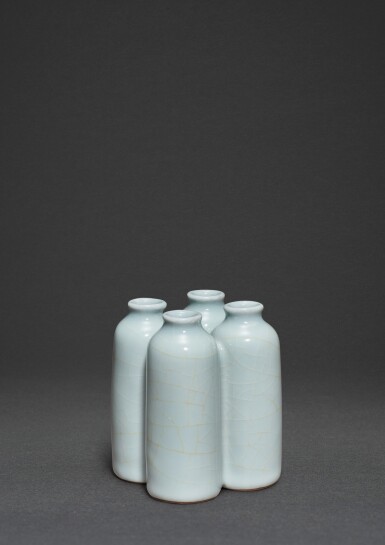
A rare guan-glazed quadruple vase, Seal mark and period of Yongzheng | 清雍正 仿官釉四連瓶 《雍正年製》款
Auction Closed
April 9, 08:16 AM GMT
Estimate
1,200,000 - 1,500,000 HKD
Lot Details
Description
Property from an important European collection
A rare guan-glazed quadruple vase,
Seal mark and period of Yongzheng
重要歐洲收藏
清雍正 仿官釉四連瓶 《雍正年製》款
finely potted as four conjoined vases of slender cylindrical form with a short waisted neck, covered overall in an unctuous soft bluish-grey glaze suffused with a matrix of golden crackles, the footrings applied with dark brown dressing, each base inscribed with one character of the four-character seal mark in underglaze blue
9.9 cm
Acquired from Edward T. Chow (1910-80) in the late 1960s.
----------------------------------------------
1960年代末購自仇焱之(1910-80年)
Conjoined vases of this charming and unusual form were an innovation of the Yongzheng reign, and the present vessel, which echoes the unctuous glazes of the finest Song dynasty prototypes, would have required the craftsmen's utmost attention in potting and firing. Remarkable in its well-proportioned form and even luminous glaze, the vase attests to the ingenuity in utilising historical precedents in the creation of new works that met the Yongzheng Emperor's exacting standards for quality and reverence of China's glorious heritage.
While delicate, almost watery, celadon glazes had already been created in the Yongle period, this pale green tone, achieved by lessening the amount of iron typically found on Song dynasty Longquan celadons, began to be produced in the Kangxi reign. During the Yongzheng period, the production of wares greatly expanded. From the first years of his reign, the Yongzheng Emperor commissioned works from the Palace Workshops inspired by treasured Song dynasty antecedents held in the imperial collection. These antiques were used as standards for quality, models for archaistic designs and as inspirations for innovation. In 1735, Tang Ying, the celebrated superintendent of the imperial kilns at Jingdezhen, composed the Taocheng jishi bei ji [Commemorative stele on ceramic production], in which several varieties of celadon glazes were recorded to have been experimented with at the time (see Stephen W. Bushell, Oriental Ceramic Art. Illustrated by Examples from the Collection of W.T. Walters, New York, 1896; reprint London, 1981, p. 197).
A slightly smaller vase of this type in the Palace Museum, Beijing, is illustrated in Qingdai yuyao ciqi [Qing imperial porcelains], vol. 1, Beijing, 2005, pl. 149; two were sold in these rooms, the first, 24th May 1985, lot 503, and the second, 9th October 2020, lot 22; and another was sold in our New York rooms, 20th March 2019, lot 518, from the collection of Stephen Junkunc III.
Vases of this form with Yongzheng marks and of the period, are also known to be covered in other monochrome glazes: see an example with a Ru-type glaze, in the Palace Museum, Taipei, included in the museum's exhibition Qing Monochrome Porcelain, Taipei, 1981, cat. no. 77; a celadon-glazed example from the J.M. Hu Collection, sold in our New York rooms, 4th June 1985, lot 40; and a slightly smaller version covered in a teadust glaze, also sold in our New York rooms, 21st March 2018, lot 536.
----------------------------------------------
此類四連瓶器形別緻,悅目賞心,為雍正朝首創;塑胎、燒窰皆不遺餘力,唯求再現宋代官釉瑩如凝脂之態。此四連瓶佈局得當,罩釉勻實,可見巧匠心裁獨到且技藝純熟,賦古韻予新器,尤合雍正帝精嚴之治、好古之心。
青釉淡淨如水,早見於明代永樂一朝,而至康熙年間,工匠取宋明兩朝之菁華,以宋代龍泉釉藥配方為範,篩減其釉方含鐵量,成功燒出如本品般瑩潤婉約之釉色。雍正一朝慕而傚之者猶如百花齊放。即位之初,雍正命宮廷作坊依皇家珍藏宋代名品產燒新瓷,無論質、形、紋飾等,均以宋器為典範。1735年,景德鎮督陶官唐英集成《陶成紀事碑記》,載述試燒青釉若干種,詳見卜士禮,《Oriental Ceramic Art. Illustrated by Examples from the Collection of W.T. Walters》,紐約,1896年,倫敦,1981年再版,頁197。
可比一例,形制相同,尺寸略小,藏北京故宮博物院,錄《清代御窰瓷器》,卷1,北京,2005年,圖版149;另比兩件,售於香港蘇富比,其一,1985年5月24日,編號503,其二,2020年10月9日,編號22;仍有一件,瓊肯三世舊藏,售於紐約蘇富比2019年3月20日,編號518。
雍正年款四連瓶亦有施其他單色釉者,如一例,施仿汝釉,藏台北故宮博物院,展於《清代單色釉瓷器》,台北,1981年,編號77;胡惠春舊藏一例,施冬青釉,售於紐約蘇富比1985年6月4日,編號40;及一例略小,施茶葉末釉,售於紐約蘇富比2018年3月21日,編號536。