The Victor Shaw Collection of Chinese Jades 邵維錫藏中國玉雕
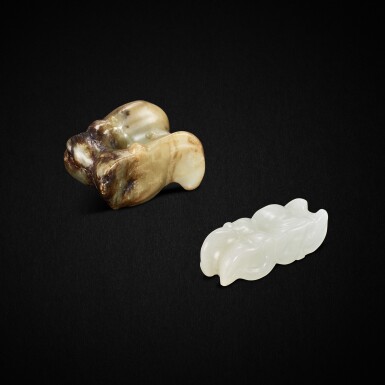
Two jade astragal pendants, Jin - Yuan dynasty 金至元 玉雕嘎拉哈一組兩件
Lot Closed
August 3, 03:27 AM GMT
Estimate
20,000 - 40,000 HKD
Lot Details
Description
The Victor Shaw Collection of Chinese Jades 邵維錫藏中國玉雕
Two jade astragal pendants,
Jin - Yuan dynasty
金至元 玉雕嘎拉哈一組兩件
Astragalus bone is called Gā hā lā in the Jurchen language. It was originally used as a divination or chess-playing tool. The custom of women and children wearing sheep astragalus bones dates back to the Jin Dynasty and continued until the Qing Dynasty. Each of the four sides has a specific name, as recorded by Xu Lan (active in 17th century) in Sai Shang Za Ji: "The bone is divided into four sides, with the side resembling clouds called Zhen'er, the back of Zhen called Gui'er, the side facing down called Bei, and the side facing up called Shao."
Compare with a highly related jade astragalus bone pendant in Tianjin Museum, Jin dynasty, illustrated in Jades Wares Collected by Tianjin Museum, Beijing, 2012, no. 150.
嘎哈啦為女真語,即漢語之羊距骨,本為占卜或棋弈工具。婦女小孩佩戴羊距骨為金代習俗,延續到滿清。四面皆有專屬名稱,清人徐蘭《塞上雜記》記載:「骨分四面,有棱起如雲者為珍兒,珍背為鬼兒,俯者為背,仰者為稍。」可參考天津博物館藏一件金代白玉嘎哈啦墜,見《天津博物館藏玉》,北京,2012年,編號150。
(2)
largest w. 4.3 cm