
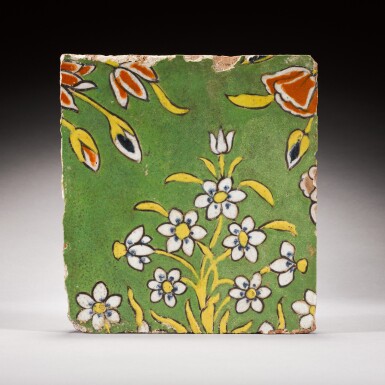
A Mughal cuerda seca pottery tile, North India or Lahore, 17th century
Auction Closed
October 25, 12:38 PM GMT
Estimate
4,000 - 6,000 GBP
Lot Details
Description
decorated in the cuerda seca technique with green, yellow, orange, white and blue glazes, the reverse with old exhibition label 'Fogg Art Museum / LOAN', label bearing inventory number in red ink and pencil '17512.7a / Welch'
19.2 by 21cm. (7 ½ by 8 ¼in.)
On loan at the Fogg Art Museum, Harvard University, probably 1983
The design and colours of the present lot are very similar to a tile which is part of a group of four tiles, forming the upper left section of the design in the group, in the collection of the Victoria & Albert Museum, London (acc.no. IM.266-1923; Skelton 1982, p.26, no.5). These tiles were given to the museum by Mr. Frederick H. Andrews who acquired them in Srinagar in 1923. They are thought to be from the tomb complex of Sayyid Muhammad Hussain Madani, a foreign envoy who was sent to India by the Mongol ruler, Timur, at the end of the 14th century. Although Madani’s tomb in Srinagar dates from the mid-15th century, these tiles were produced later during the reign of the Mughal Emperor Shah Jahan (r.1628-58) when a ceremonial gateway leading to the tomb and mosque was constructed, decorated with polychrome tiles of similar design.
You May Also Like


