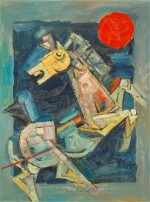

Property from a Private Collection, Dubai
Maqbool Fida Husain
Untitled (Horse)
Auction Closed
October 24, 04:35 PM GMT
Estimate
100,000 - 150,000 GBP
Lot Details
Description
Property from a Private Collection, Dubai
Maqbool Fida Husain
1913 - 2011
Untitled (Horse)
Oil on canvas
Signed in Devanagari and Urdu lower right
73.5 x 55.7 cm. (28 ⅞ x 21 ⅞ in.)
Throughout his career, Maqbool Fida Husain has repeatedly depicted horses in his works as symbols of power and wild, raw energy. An interest that began at a young age, the image of the horse is an icon both in Husain’s life and in Indian art. As a young boy, Husain’s grandfather took him to visit the local farrier, where he met horses of all types: thoroughbreds, polo ponies, cavalry horses and the common horse that pulled local carts. During the annual Muharram processions, he was immersed in the tazias of Imam Hussain’s faithful horse and its story of martyrdom. As a young artist, Husain was ‘observing and drawing horses in their perfect form and likeness using coal or pieces of chalk on the walls of his school and in his notebooks.’ (R. Siddiqui, M.F. Husain: In Conversation with Husain Paintings, Books Today, New Delhi, 2001, p. 110)
Beyond his experiences in India, horses are also an important representation of Husain’s international influences. In the early 1950s, Husain visited Italy where he discovered the equestrian sculptures of the Italian sculptor Marino Marini. During this time, he also visited China and studied the pottery horses of the Tang dynasty and the equine Chinese ink paintings of Xu Beihong (1895 – 1953) and Qi Baishi (1864-1957), who was known for his monochromatic paintings of animals with their minimalist use of line to achieve form and movement.
So fascinated was Husain by the horse that the subject remained a leitmotif throughout his storied artistic career, appearing frequently in his paintings. These portrayals of animalistic beauty erupt across the canvas, as evidenced in the current lot. Set within a rich teal background, the painting is bordered in shades of vibrant green. In addition, Husain depicts a blazing red sun in the upper-left corner, perhaps a nod to the myth of the seven horses who drew the chariot of the sun god, Surya. As referenced by the red arrow piercing the horse’s buttocks, this work likely immortalizes the famed white horse (Duldul) that Husain commemorated since a young age during Muharram. Ambushed by a neighboring general, Imam Hussain and his companions were brutally attacked with a shower of arrows. This story became ingrained in Husain after he visited Iraq in 1965, making a pilgrimage to Karbala to witness the battleground where Imam Hussain fell.
With powerful lines and strong palette knife work, Husain combines colours in each stroke to create a kaleidoscopic effect that is a testament to his exceptional skill and unparalleled talent.
You May Also Like


