
Property of a Gentleman | 士紳收藏
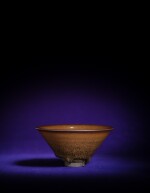
An heirloom Jian russet-streaked 'nogime tenmoku' bowl, Southern Song dynasty | 南宋 建窰兔毫禾目天目茶盞
Auction Closed
October 9, 03:24 AM GTNN
Estimate
2,000,000 - 3,000,000 HKD
Lot Details
Description
Property of a Gentleman
An heirloom Jian russet-streaked 'nogime tenmoku' bowl,
Southern Song dynasty
士紳收藏
南宋 建窰兔毫禾目天目茶盞
11.5 cm
Based on the heirloom patina, most likely passed down in Japan since medieval t.mes s.
collects ion of Rolf Cunliffe (1899-1963), 2nd Baron Cunliffe of Headley (no. T6).
Bonhams London, 11th November 2002, lot 40.
The Le Cong Tang collects ion.
Sotheby's Hong Kong, 2nd October 2017, lot 12.
據皮殼判斷,應曾自中世紀日本傳世
第二代 Cunliffe of Headley 男爵 Rolf Cunliffe(1899-1963年)收藏(編號T6)
倫敦邦翰斯2002年11月11日,編號40
樂從堂收藏
香港蘇富比2017年10月2日,編號12
The unprecedented enthusiasm for tea drinking in the Song dynasty (960-1279) brought about a tea culture that contributed to the development of various new ceramic tea wares. White and celadon-glazed tea bowls were replaced in popularity by black-glazed wares, whose dark surfaces provided a more dramatic backdrop for the white froth of the whipped tea. In Chalu [Record of Tea], written between 1049 and 1053, the leading calligrapher and tea connoisseur Cai Xiang (1012-1067) notes in the section devoted to ‘Tea Bowls’ (chazhan) that if “the tea is of a pale colour, a black bowl is the best match. Bowls fired in the Jian kilns have a bluish black colour with stringy décor like hare’s fur (tuhao). The somewhat thicker bowl preserves the heat and cools slowly after having been warmed. These bowls are therefore very much in demand” (Soon-Chim Jung, ‘The Significance and Influence of the Tea Culture of the Song Dynasty’, The Monochrome Principle. Lacquerware and Ceramics of the Song and Qing Dynasties, Munster, 2008, p. 117). The Huizong Emperor (r. 1100-1126), one of China’s greatest imperial art lovers, agreed with Cai’s views and in his treatise on tea, Daguan chalun [Discourse on tea in the Daguan reign period] written in 1107, noted that the best black bowls have the hare’s fur pattern (ibid.).
The Japanese word temmoku (or tenmoku) designates the Chinese Tianmu mountains in Lin’an county, north Zhejiang province, where Jian hare’s fur (Japanese nogime) bowls, made in the neighbouring province of Fujian, were in use for tea drinking by the monastic communities who lived there. Consumption of tea was an established practice in Buddhist monasteries, as tea was prized as a stimulant in assisting monks in their meditation, as well as being ritually offered to the Buddha. When Japanese monks brought the black Jian tea bowls to Japan together with the cult of tea, they were adopted with enthusiasm.
The present bowl is notable for its glossy glaze and the evenness of the russet-coloured hare’s fur pattern, which untypically covers most of the bowl. It is further remarkable for its steep conical shape resting on a very narrow foot, which makes this bowl more elegant than the typical, more rustic tea bowls from the Jian kilns with more rounded sides and a wider foot, or of conical shape but much larger. Bowls of this form are rare, as can be seen when comparing the many line drawings of tenmoku bowls published in Tōbutsu tenmoku [Import commodity ‘tenmoku’], Chadō Shiryōkan, Kyoto, 1994, passim, where a bowl of related proportions, but somewhat larger and with the glaze retaining more black, preserved in the Tokugawa family and now in the Tokugawa Art Museum, Nagoya, is illustrated, pl. 11. A bowl with russet hare’s fur streaks similarly predominating, but of the more classic Jian tea bowl form, in the Capital Museum, Beijing, is published in Zhongguo taoci quanji [Complete series on Chinese ceramics], Shanghai, 1999-2000, vol. 8, pl. 206.
Lord Cunliffe was one of England’s most important collects ors of Chinese works of art, who started in the early 1940s to collects Qing dynasty jades, soon followed by ceramics, archaic bronzes and early jades. His collects ion included many famous treasures, including no less than three blue-and-white Chenghua ‘palace bowls’. A large part of his collects ion was sold in our London rooms, and the present bowl at Bonhams London.
宋朝品茶風尚之盛,前所未見,蔚然成風,多種瓷製茶具因而出現。黑釉潤亮,托襯點茶擊拂茶水後,所得茶面細沫,白黑相映,極為耀眼,故而盛行,取代白釉及青釉器茶具。茗茶家兼書法家蔡襄(1012-1067年),在皇𧙗元至五年(1049-1053年)著《茶錄》中曰:「茶色白,宜黑盞,建安所造者,紺黑,紋如兔毫,其胚微厚,熁之久熱難冷,最為要用」。 宋徽宗 (1100-1126年在位),醉心藝文之極,問鼎歷代帝王之冠,所見也與蔡襄相同,認為黑盞尤以兔毫為佳,在大觀元年(1107年)成書《大觀茶論》中指:「盞色貴青黑,玉毫條達者為上,取其燠發茶採色也」。
兔毫茶盞,窰縱處福建,日人以浙江以北之臨安天目山命名,稱之「天目」,以為山上佛寺僧人以建窰兔毫茶盞茗茶。茶道為佛教寺廟傳統,皆因清茶提神,有益於坐禪冥想,更可供佛。建盞及品茶文化,隨日本僧人歸國傳入,深受當地推崇。
此盞釉面盈潤,褐色兔毫紋勻稱,且全盞幾近滿釉,極為罕見。此盞古樸素雅,撇口斜壁,圈足纖巧,外侈幅度使其更形秀麗,較典型寬足弧腹婉約,又較一般尺寸較大之笠式盞可愛。此器形之珍罕,各式天目盌之線描圖可作輔證,詳見《唐物天目》,茶道資料館,京都,1994年。書載一例,盞形比例與此相近,尺寸稍大,釉色較黑,德川家族舊藏,現存名古屋德川美術館,圖版11。另比較一例,兔毫紋大致相近,惟形屬建盞大宗,現存北京,載於《中國陶瓷全集》,上海,1999-2000年,卷8,圖版206。
Cunliffe 爵士,英國最重要中國藝術收藏家之一,四十年代開始收藏清代玉器,後開始收藏瓷器、青銅、高古玉器等,珍品雲集,包括成化青花宮盌三盌。收藏中多件售於倫敦蘇富比,本品曾售於倫敦邦瀚斯。
You May Also Like


