
Property of a Lady | 女史收藏
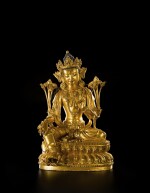
A rare gilt-bronze seated figure of Avalokiteshvara, Mark and period of Yongle | 明永樂 鎏金銅觀世音菩薩坐像 《大明永樂年施》款
Premium Lot
Auction Closed
October 9, 09:17 AM GTNN
Estimate
4,000,000 - 6,000,000 HKD
Lot Details
Description
Property of a Lady
A rare gilt-bronze seated figure of Avalokiteshvara,
Mark and period of Yongle
女史收藏
明永樂 鎏金銅觀世音菩薩坐像 《大明永樂年施》款
the front of the base incised with a horizontal six-character mark
21.5 cm
collects ion of Tuyet Nguyet and Stephen Markbreiter.
Sotheby’s Hong Kong, 7th October 2010, lot 2146.
Tuyet Nguyet(雪月)及 Stephen Markbreiter 伉儷收藏
香港蘇富比2010年10月7日,編號2146
The popularity of Avalokiteshvara in early Ming China is evident from the numerous Yongle and Xuande sculptures representing different forms of the deity. In this delightful Yongle bronze, he is depicted in a form that has been popular in China from at least the Tang dynasty, where in sculpture and painting he is shown holding the elixir bottle and lotus, Wladimir Zwalf, ed., Buddhism: Art and Faith, London, 1985, cat. no. 291. A Five Dynasties painting and a Five Dynasties woodblock print dated 947 are both inscribed with similar verse in praise of the Great.mes rciful, Great Compassionate Saviour from Hardship, Avalokiteshvara Bodhisattva, ibid., cat. nos. 317 and 330. Both depict the bodhisattva with a bottle and lotus flower, and Roderick Whitfield identifies the vessel as a medicine bottle. A further Five Dynasties woodblock print shows the bodhisattva with the bottle and a willow branch, both symbols of healing, ibid., cat. no. 334. The manifestation of the bodhisattva depicted in the Yongle bronze is thus traditionally popular in China, and the association with medicine may suggest a cult relating to health and well being amongst devotees.
Although the style of the bronze is much influenced by Himalayan sculptural traditions, this form of Avalokiteshvara is not popular in Tibet: which seems to highlight a traditionalism in those responsible for the court's iconographic program, independent of Tibetan customs. This and indeed all the different Yongle and Xuande forms of the bodhisattva are modelled in the 'Indian' manner as a male deity, as opposed to the sinicised female aspect. This preference may be intended to reflect the form and gender of the deity as originally introduced into China from India, which would also be more in keeping for Tibetan Buddhists who were often the recipients of such sculptures. At least three other Yongle examples of this iconography remain, including one in the Potala collects ion, Lhasa: Ulrich von Schroeder, Buddhist Sculptures in Tibet, Hong Kong, 2001, no. 355A. Another from the Berti Aschmann collects ion is now in the Rietberg Museum: Helmut Uhlig, On the Path to Enlightenment, Zürich, 1995, cat. no. 52; and a third is in collects ion J.P.H.Y., Belgium: Jan van Alphen, Cast for Eternity, Antwerp, 2004, cat. no. 78.
In this evidently popular manifestation of Avalokiteshvara the accessible nature of the bodhisattva is reflected in the open and relaxed posture and the charitable gesture of the right hand: painted eyes and lips enhance the compassionate downward gaze. Just the slightest wear to the gilding on this elegant example suggests respectful and gentle handling over the centuries.
永宣二朝,觀音造像諸式多變,足證觀音信仰在明初之盛。此永樂觀音坐像,執蓮持瓶,沿取唐時已見風行之態,澄心悅目。唐朝握持長壽寶瓶與蓮花之觀音法相,常見於雕塑與繪畫上,參見 Wladimir Zwalf 編,《Buddhism: Art and Faith》,倫敦,1985年,編號291。同書另載一五代繪畫,以及一紀年947年之五代木刻版畫,皆飾有持瓶執蓮之菩薩,且有誦讚大慈大悲救苦救難觀世音菩薩之詞句,出處同上,編號317及330。Roderick Whitfield 指,此二幅五代菩薩像中寶瓶乃藥瓶。另參考一五代木刻版畫,見觀音菩薩握持淨瓶柳枝,象徵驅疾治病,出處同上,編號334。本尊菩薩坐像拈蓮握瓶,與傳統中國盛行之觀音形象相乎,承載信眾祈求菩薩救病去疾、慈懷濟世之願。
此尊鎏金像,雖見喜馬拉雅地區塑像藝風的影響,此式之觀音像在西藏卻並不普見,似乎永樂宮廷佛像風格之倡導者,並未受西藏當地佛教風俗之影響。事實上,不只是此尊,永宣年間觀音菩薩造像,均循印度風格作男相,有別於漢式女相。此舉或為還原當初觀世音菩薩自印度傳入中國的原始法相,而且此類造像多為藏傳佛教信眾而製,是以男相更見合宜。與此相類之菩薩像例,至少有三。拉薩布達拉宮藏一尊,見於 Ulrich von Schroeder,《西藏佛教雕塑》,香港,2001年,編號355A,另 Berti Aschmann 收藏一尊,現存瑞士萊特堡美術館,見於 Helmut Uhlig,《On the Path to Enlightenment》,蘇黎世,1995年,編號52,還有一尊屬比利時J.P.H.Y.寶蓄,見 Jan van Alphen,《Cast for Eternity》,安特衛普,2004年,編號78。
觀音姿態安逸親和,右手作慈悲手印,展現菩薩和藹可親之特質,眼唇施彩,突顯垂目俯視,盡顯法相慈悲。歷數百載,僅見鎏金輕磨,足見信徒對坐像之珍重崇敬。
You May Also Like


