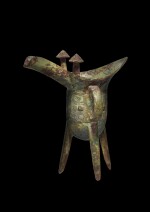

An inscribed archaic bronze ritual wine vessel, jue, Shang dynasty, 12th - 11th century BC | 商 公元前十二至十一世紀 子丙爵
Auction Closed
April 8, 02:15 PM GMT
Estimate
180,000 - 220,000 HKD
Lot Details
Description
An inscribed archaic bronze ritual wine vessel, jue,
Shang dynasty, 12th - 11th century BC
商 公元前十二至十一世紀 子丙爵
cast beneath the handle with two characters reading zi bing
h. 18.8 cm
Probably John Sparks, London.
Collection of Hans G.W. Peters, London, probably acquired from the above in 1960.
Eskenazi Ltd, London, 2004.
Collection of Mr and Mrs Joseph E. Poser, acquired in 2004.
J.J. Lally & Co., New York.
傳 John Sparks,倫敦
Hans G.W. Peters 收藏,倫敦,或於1960年購自上述來源
埃斯卡納齊,倫敦,2004年
Joseph E. Poser 伉儷收藏,購於2004年
藍理捷,紐約
The pictogram bing, flanked by two tiny apostrophes, has been proposed to be referring to the Bing State, see Yin Weizhang and Cao Shuqin, 'Lingshi Shang mu yu Bingguo tongqi [Shang Tomb in Lingshi and Bronzes of Bing State]', Kaogu, Beijing, July 1990, pp. 621-39, where the authors note that Bing State bronzes can be traced back as early to the Wuding period of the Shang dynasty through early Western Zhou, with about 100 ritual vessels bearing the same pictogram, or more appropriately, state emblem. It has been also pointed out that it is remarkable for a vassal state of this period to have this astounding number of inscribed bronzes, suggesting the importance and status of the Bing State.
The phrase zi bing has also been recorded twice on the oracle bones from Huayuanzhuang East; several scholars proposed it could be referring to a specific person, however, such interpretation is still up for debate academically. For detailed discussions, see Hwang Ming-chorng, 'The Meaning of the Heavenly Stems as Designators for Lineages and the Related Marriage Taboo of the Shang Elite', Bulletin of the Institute of History and Philology Academia Sinica, vol. 78.4, Taipei, pp. 705-54.
Starting in the early 1950s, Hans Peters assembled his collection primarily with the assistance of London dealers such as Bluett & Sons, John Sparks, Sydney Moss and Barlings, although he would acquire the occasional piece at auction. His two primary collecting areas in Chinese art were metalwork, encompassing archaic bronzes, mirrors, belt hooks, and early Chinese ceramics including Han vessels and Tang figures. Although Peters continued to collect through to the 1980s, his most important acquisitions were made during the 1960s. He kept a meticulous record of all his purchases, including original invoices, notes of repairs, rubbings of inscriptions, as well as the occasional sale of an object at auction.