
Property from the Robert L. McNeil, Jr. Trust
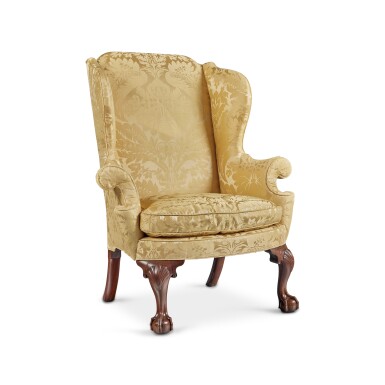
Very Fine and Rare Chippendale Shell-Carved Mahogany Easy Chair, Philadelphia, Pennsylvania, Circa 1755
Auction Closed
January 23, 04:26 PM GMT
Estimate
15,000 - 25,000 USD
Lot Details
Description
Very Fine and Rare Chippendale Shell-Carved Mahogany Easy Chair
Philadelphia, Pennsylvania
Circa 1755
Height 47 1/4 in. by Width 38 in. by Depth 28 in.
David Stockwell, Wilmington, Delaware, February 1965.
With its elegantly sweeping serpentine crest, shaped wings, horizontally rolled arms with accompanying C-scrolls, bowed seat rail, raked rear legs, and front cabriole legs with shell-carved knees and claw feet, this easy chair represents one of the finest achievements of Philadelphia chairmaking. Showcasing the work of the chair maker, carver, and upholsterer, chairs of this type were a luxury in the colonial home due to the significant costs associated with their upholstery, and, as such, specially commissioned by their wealthy owners.
Two closely related easy chairs were originally owned by John Brown (1736-1803), the prominent Providence merchant. One made of walnut was sold at Sotheby’s, Important Americana, January 19-21, 2007, sale 8278, lot 586. The other of mahogany appears without upholstery in a John Walton advertisement in The Magazine Antiques for November 1974. Both were supplied to John Brown by Plunket Fleeson, the Philadelphia upholsterer, in 1761 and 1764, and documented by two invoices dated 1762 and 1764, respectively. John Brown ordered the easy chairs through the Philadelphia firm of Tench Francis and John Relfe, and paid £9/18/03 1/2 for the chair ordered in 1761 and £11/13/11 for the second chair in 1764. The majority of price for the latter was for the upholstery, with £3/20/0 of the cost for making the frame.
William MacPherson Hornor recognizes a very similar walnut easy chair in Blue Book Philadelphia Furniture as “possibly Philadelphia’s most significant design contribution … illustrating complete artistic control of line particularly in the vertical horizontal roll of the arms resulting in a pronounced C scroll terminating in the compass or balloon shaped seat.”1 An additional related example can be found in the collections of the Henry Francis DuPont Winterthur Museum.2 A third with its original surface was sold in these rooms, Property of Rear Admiral Edward P. Moore and Barbara Bingham Moore, September 26, 2008, sale 8446, lot 20.
1 William M. Hornor, Blue Book Philadelphia Furniture, 1935, reprint 1988, p. xxvi.
2 Joseph Downs, American Furniture, Queen Anne and Chippendale Periods, 1952, no. 85.
You May Also Like


