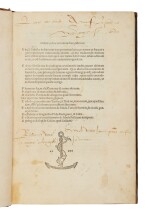

Aesopus, Venice, Aldus, 1505, later mottled calf, Sussex-Walpole-Soragna copy
Auction Closed
October 12, 08:25 PM GMT
Estimate
20,000 - 30,000 USD
Lot Details
Description
Aesopus. Vita & fabellae Aesopi cum interpretatione Latina… Gabriae Fabellae tres & quadraginta... cum latina interpretatione... Phurnutus seu, ut alii, Curnutus de natura deorum. Palaephatus de non credendis historiis. Heraclides Ponticus de allegoriis apud Homerum. Ori Apollinis Niliaci hieroglyphica... (Venice: Aldo Manuzio, October 1505)
Aldo’s 1505 folio is an eclectic compilation of Greek texts, first editions except for the Aesop prose corpus, which was first printed, also with a Latin translation, in Milan by Bonus Accursius, ca. 1478. Added to this are 4-line metrical fables attributed to Gabria (Babrios), now assigned to Ignatius the Deacon (9th century); a treatise on the gods by L. Annaeus Cornutus (1st century C.E., teacher of Lucan and Persius); a mythographic treatise "on incredible things" assigned to an otherwise unknown author Palaephatus; an incomplete text of the Quaestiones Homericae of the first century C.E.; Heraclitus, here assigned to Heraclides Ponticus, pupil of Plato; the fifth century C.E. treatise Hieroglyphica of a presumably apocryphal Horapollo, which became strongly influential on 16th- and 17th-century emblem literature and iconography; and a large corpus of Greek proverbs. A smaller collection of proverbs, that of Zenobius, had been printed in Venice, 1497, by Giunta and Ricardinus, but Aldo notes that the present collection is greatly expanded from Suda and other sources. The "Gabria" metrical fables were printed twice in succession, Aldus explaining that in the course of production he had come across a superior manuscript, from which the errors found in their first setting could be corrected.
The first four quires consist of separately signed Latin (A-D) and Greek (a-d) sheets, meant to be interleaved so that Greek text would face the Latin translations; the system breaks down at the middle of each quire, where Latin faces Latin, or Greek faces Greek. As a result, the first three texts, Aesop, "Gabria" and Cornutus become confusingly broken up in the successive pages of quire D; on the colophon page, Aldo acknowledges the awkwardness, "which could not be avoided." The first section of the book was paginated on the Greek sheets (a-i), starting with p. 17 on b1r and ending p. 242 on i6v. The second section, the alphabetical corpus of proverbs, was independently laid out with Greek-letter quiring and double columns of 46 lines, the columns numbered from 1 to 272.
Chancery folio (271 x 175 mm). Greek and roman type, 45 lines plus headline (Latin sheets), 46 lines (Greek sheets). collation: a-A8-8 B-b10-8 c-C8-8 D-d10-8 e-h8 i6; κ-ξ8 o4: 150 leaves. Woodcut Aldine device on title and final verso. (Occasional light staining, stain at foot of gutter part way through the volume.)
binding: Eighteenth-century mottled calf (277 x 189 mm), gilt fillet border, spine gilt in compartments with red morocco lettering-piece, sprinkled edges. (Binding scraped and repaired.)
provenance: Early notes in French on title-page and at end — Augustus Frederick, Duke of Sussex (1773-1843), armorial bookplate, sale, Evans, 30 January-10 February 1845, lot 218, 11s, to Henry Bohn — Horatio William Walpole, 4th Earl of Orford (1813-1894), armorial bookplate, sale, Replica Shoes , Wilkinson & Hodge, 10-11 June 1895, lot 2 — Camillo Meli Lupi, principe di Soragna (1873-1954), bookplate. acquisition: Purchased from Carlo Alberto Chiesa, Milan, 1992. references: UCLA 93 (with detailed listing of the fables); Aldo Manuzio tipografo 95; Edit16 334; Renouard 49/6. On "Gabria", see Martin Sicherl, Griechische Erstausgaben des Aldus Manutius (Paderborn, 1997), pp. 352-56


