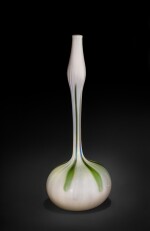

Tiffany Studios
"Egyptian Onion" Flower-Form Vase
Auction Closed
December 8, 12:14 AM GMT
Estimate
10,000 - 15,000 USD
Lot Details
Description
Tiffany Studios
"Egyptian Onion" Flower-Form Vase
circa 1900
Favrile glass
engraved LCT/N7380 with the firm’s paper label
12⅛ inches (30.8 cm) high
Novel Forms –
The "Flower-Form" Technique
Louis C. Tiffany’s love of nature, particularly flowers, was apparent in much of his artistic creations, from his earliest paintings and interior decorations to the later objects produced by Tiffany Studios. It is therefore not at all surprising that the first truly distinctive shape produced by his glasshouse was the Flower-Form.
Tiffany’s Stourbridge Glass Company, later named Tiffany Furnaces, began producing blown glass objects in late 1893. These pieces were first publicly displayed as a largely ignored component of the company’s February 1894 exhibition in New York City of its famous Chapel, made for the Columbian Exposition. Included were “holders for single flowers, shaped like tulips just opening.” These earliest attempts at the form were relatively crude, usually consisting of a variegated and swirled glass bowl supported on a thick, sometimes sinuous, stem raised on an applied circular foot. Many were given a matte acid finish and the stems were occasionally enhanced with slender threads of colored glass extending to the bowl, where they were manipulated to represent petals.
Thomas Manderson, the firm’s gaffer credited with developing the Flower-Form motif, quickly improved his glassmaking techniques and a multitude of highly refined shapes and decorations were produced within a remarkably short time span. Perhaps the impetus came from Louis C. Tiffany’s brilliant sense of marketing, with the company advertising in March 1895 a collection of Favrile glass that “includes a variety of new and interesting shapes. Many colors in flower forms especially made for Easter.” Whatever the catalyst, critics were quick to give these vases exceptionally favorable reviews: “The shapes, too, are delightful in their simplicity. Mr. Tiffany has gone long beyond the time in the experience of most artists when they want to adorn that which is itself an adornment… There are other pieces that are like flowers and plants. There are some that have bulbs and twine upward as a vine as a tulip does. There are others that bring to mind hyacinths and narcissi. They are all beautiful, and Mr. Tiffany is to be congratulated on having brought into the world a new art.”
Egyptian Onions are a variety of alliums found throughout the United States and are unusual in that the plant sets its bulb at the top, each containing several small onions that can be harvested. These two examples (lots 221 and 222), which are now referred to as Egyptian Onions, were among the earliest flower-forms produced by the Tiffany glasshouse. The shape is first mentioned in a 1900 magazine article, the time these two vases were made: “One of the vases had a novel form, in that it appeared to sprout from an onion for a base, with a peculiar texture, neither polished nor dull.”
The Cameo Flower-Form offered here (lot 223) is exceptionally rare, with only approximately a dozen known to be in existence. The thin glass bowl was cased, or covered, with translucent green and opalescent white glass. Once the vase had thoroughly cooled, these outer layers were finely carved on an engraving wheel into delicate green leaves and gently folded and ribbed white petals. Extreme care was required of the engraver, as the relatively thin bowl would shatter if even the slightest excess pressure was applied.
- PD


