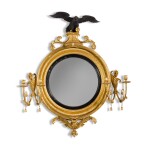

A pair of Regency giltwood and ebonised convex mirrors, circa 1810, by Richard Jackson, Essex Bridge, Dublin
Auction Closed
May 26, 03:18 PM GMT
Estimate
15,000 - 20,000 GBP
Lot Details
Description
A pair of Regency giltwood and ebonised convex mirrors, circa 1810, by Richard Jackson, Essex Bridge, Dublin
the convex mirror plate within an ebonised slip, and a gadrooned border, surmounted by an eagle, flanked by two giltwood candle arms to each side, and with a scrolling acanthus apron, re-gilt, one bearing label 'JACKSON / No 5 / Essex Bridge / DUBLIN', the other with an ink inscription reading 'Arthur Williams / Sept 29 1807'
one 132.5cm. high, 113cm. wide; 4ft 4¼in., 3ft. 8½in.; the other 134cm. high, 118.5cm. wide; 4ft. 5 in., 3ft. 10¾in.
Christie's London, Important English Furniture, 13 November 1997, lot 124 (£60,000).
These convex mirrors, adorned by martial motifs of an eagle and flaming torches, are characteristic of the Regency 'antique' manner made popular by Thomas Sheraton's 1803 Cabinet Dictionary and George Smith's 1808 Collection of Designs for HouseholdFurniture and Interior Decoration.
The label on the reverse refers to Richard Jackson (1786-1827), the inheritor of a family business whose 'looking-glass warehouse' was based on Essex Bridge, Dublin from 1759 to 1827. His label is also recorded on a pair of sconces in the collection of Hugh Massy, Esq., at Stoneville, Co. Limerick (The Knight of Glin, 'Dublin Directories and Trade Labels', Furniture History, 1985, p. 267 and fig. 14). One mirror is inscribed by Arthur Williams and dated 1807 and it is most likely that Williams was a craftsman working for Jackson and possibly a member of the family firm that later became Mack, Williams and Gibton.
You May Also Like


