
Property from a Philadelphia Private collects ion
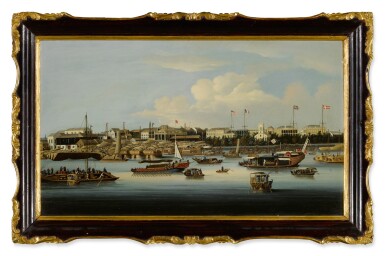
A View of the Hongs at Canton Qing Dynasty, Daoguang / Xianfeng Period, Circa 1850 | 清道光 / 咸豐 約1850年 廣州十三商館 油彩 裝框
Lot Closed
January 24, 09:23 PM GTNN
Estimate
15,000 - 25,000 USD
Lot Details
Description
Property from a Philadelphia Private collects ion
A View of the Hongs at Canton
Qing Dynasty, Daoguang / Xianfeng Period, Circa 1850
清道光 / 咸豐 約1850年 廣州十三商館 油彩 裝框
oil on canvas, depicting the American, French, British and Danish factories on the Canton waterfront next to the church, the pearl river bustling with Chinese figures on junks and other vessels, gilt-wood frame
17 1/2 in. by 30 1/2 in.; 44.1 cm by 77.5 cm
Charlotte Horstmann and Gerald Godfrey Ltd., Hong Kong, 1985
The Protestant church in the center of the painting was completed in 1848, and has been a focal point of later hong paintings until it was burned down in the fire of December 1856. Compare a similar view of the hongs, illustrated in Patrick Conner, The Hongs of Canton: Western merchants in south China 1700-1900, as seen in Chinese export paintings, London, 2009, fig. 7.16. The author notes that the church is a significant symbol of Western settlement in Canton, and provided both Chinese and Western Christians a place of worship. Conner further discusses the architectural style of the church, which was more Italianate to match the appearance of the hongs, instead of the Gothic Revival style that was popular in mid-19th century Britain.
You May Also Like


