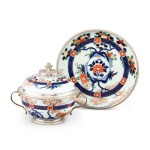
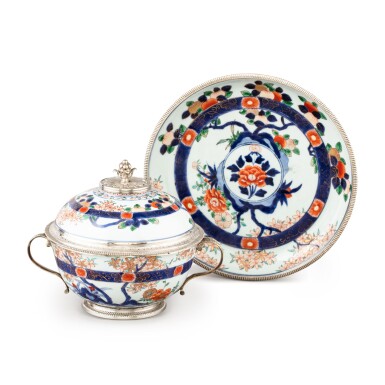
A French silver-mounted Imari porcelain bowl, cover and stand, the porcelain, Japan, circa 1700, the silver mounts, Paris, 1717-1722
Auction Closed
October 14, 11:42 AM GMT
Estimate
25,000 - 35,000 EUR
Lot Details
Description
A French silver-mounted Imari porcelain bowl, cover and stand, the porcelain, Japan, circa 1700, the silver mounts, Paris, 1717-1722
painted in underglaze blue, iron red, green and gilt with prunus and branches bearing fruit, the stand and cover mounted with gadrooned silver rims, the bowl with bifurcated scroll handles chased with leaves, the cover with bud finial issuing from leaves and circular mount chased with radiating lobes
diameter 10⅜in.; 26,3 cm.
__________________________________________________________________________
Bouillon couvert avec présentoir en porcelaine Imari montée en argent, la porcelaine, Japon, début XVIIIe siècle, les montures, Paris, 1717-1722
la porcelaine décorée de prunus et arbres fruitiers, le pied et le couvercle avec montures en argent godronné, les anses à volutes ciselées de feuilles, le couvercle à prise sur une terrasse à lobes rayonnants
diameter 10⅜in.; 26,3 cm.
D. David-Weill Collection
Sale Palais Galliera, 24 November 1971, lot 87
S.J. Phillips Ltd., London, 1998
Collection of Lily & Edmond J. Safra, New York
Sotheby's New York, 18 October 2011, lot 863
____________________________________________
Collection D. David-Weill
Vente Palais Galliera, 24 novembre 1971, lot 87
S.J. Phillips Ltd., London, 1998
Collection de Lily & Edmond J. Safra, New York
Sotheby's New York, 18 octobre 2011, lot 863
You May Also Like


