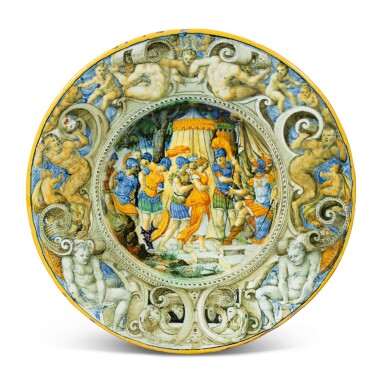
An Italian maiolica dated istoriato dish, 1545, probably Francesco Durantino, perhaps in the workshop of Guido di Merlino
Auction Closed
October 11, 05:25 PM GMT
Estimate
40,000 - 70,000 EUR
Lot Details
Description
An Italian maiolica dated istoriato dish, 1545, probably Francesco Durantino, perhaps in the workshop of Guido di Merlino
painted with `The Continence of Scipio' with a maiden brought before Scipio, surrounded by Roman soldiers before a tent, within a band of Vitruvian scrolls painted en grisaille, the border with satyr, figures and putti among scrolls within a yellow rim, the reverse inscribed ome d nãzi a Scipio / re africano fumenata / la moglie di luzio pricipe / d celtebari, above the date 1545, within concentric yellow lines
diameter 11⅞in., 30 cm.
____________________________________________
Plat en majolique italienne "a istoriato", daté 1545, probablement Francesco Durantino, provenant probablement de l'atelier de Guido di Merlino
diameter 11⅞in., 30 cm.
Christie's London, 5 July 2012, lot 84.
____________________________________________
Christie's Londres, 5 juillet 2012, lot 84.
The design of the present dish is related to the drawings of Battista Franco as illustrated by T. Wilson, Ceramic Art of the Italian Renaissance, 1987, pp. 128-9, pl. 195 and fig. xxviii and discussed by T. Clifford and J.V.G. Mallet, `Battista Franco as a Designer for Maiolica', Burlington Magazine, no. 789, June 1976, pp. 387-410. According to Giorgio Vasari, Franco was commissioned by Duke Guidobaldo II to create sketches for maiolica services working between about 1545 and 1551 and the present dish is possibly from a lost design by him.
Maiolica executed to designs by Franco in the workshop of Guido Durantino have been attributed to the potter and painter, Camillo Gatti, a pupil of Franco, see J.V.G. Mallet, `In Botega di Maestro Guido Durantino in Urbino', Burlington Magazine, no. 129, May 1987, pp. 292-4. The hand of Francesco Durantino seems a more likely attribution for the present dish, both stylistically and when comparing the handwritten inscription to other attributed pieces, for example the plate illustrated by T. Wilson, Italian Maiolica and Europe, Oxford, 2017, pp. 168-9, no. 65.
You May Also Like


