
Property from the Family of Dr. Joan Feynman
Feynman, Richard P.
Autograph Letter Signed (“RPF”), to His Sister Joan Feynman, Advising Her to Challenge Herself Academically
Lot Closed
December 13, 08:31 PM GMT
Estimate
5,000 - 8,000 USD
Lot Details
Description
FEYNMAN, RICHARD P.
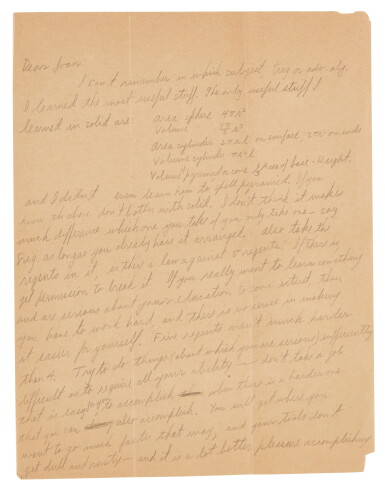
Autograph letter signed ("RPF"), to Joan Feynman ("Joan").
2 pages in pencil on single sheet (8 5/16 x 11 in.). Creases where previously folded. Slight damage to top right corner of sheet, small piece of bottom right corner of sheet absent (all text intact).
In this letter, Richard Feynman gives academic advice to his sister Joan, telling her not to take a solid geometry course in high school. He lists out the few formulas he believes are useful from solid geometry, and then advises her to take either trigonometry or advanced algebra. He also implores her to take as many Regents Exams as possible in order to challenge herself academically.
Joan Feynman would clearly take her brother's advice to challenge herself, as she would go on to become a prominent astrophysicist known for her work on understanding the origins of auroras (i.e., the polar lights), and would become the first woman elected an officer of the American Geophysical Union.
Richard Feynman's autograph letter reads, in part:
"Dear Joan:
I can't remember in which subject, trig or adv. alg. I learned the most useful stuff. The only useful stuff I learned in solid are:
Area sphere 4πr²
Volume " 4π/3 r³
Area cylinder 2πrh on surface, 2πr² on ends
Volume cylinder πr²h
Volume of pyramid or cone 1/3 Area of base ∙ Height.
and I didn't even learn how to spell pyramid. If you know the above don't bother with solid. I don't think it makes much difference which one you take if you only take one — say trig, as long as you already have it arranged. Also take the regents in it, is there a law against 5 regents? If there is, get permission to break it. If you really want to learn something and are serious about your education to some extent, then you have to work hard, and there is no sense in making it easier for yourself. Five regents aren't much harder than 4. Try to do things (about which you are serious) sufficiently difficult as to require all your ability — don't take a job that is easy for you to accomplish. You will get where you want to go much faster that way, and your tools don't get dull and rusty — and it is a lot better pleasure accomplishing hard things than easy ones."
REFERENCES: