
Property from the Estate of Philip Astley-Jones
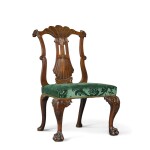
A George II carved mahogany side chair, circa 1740, in the manner of Giles Grendey
Lot Closed
May 17, 11:27 AM GTNN
Estimate
10,000 - 15,000 GBP
Lot Details
Description
Property from the Estate of Philip Astley-Jones
A George II carved mahogany side chair, circa 1740, in the manner of Giles Grendey
the lyre shaped back rest with imbricated and acanthus carved detail centred by a pierced and shell-carved splat, above a padded seat covered in close-nailed green cut-velvet, on foliate-clasped cabriole legs with hairy paw feet
These lyre-form side chairs, with pierced shell-form back splats, belong to a group of chairs traditionally attributed to the workshop of Giles Grendey, of clerks enwell, London. A set of six walnut chairs which belonged to the Earls of Poulett at Hinton House, Somerset, being attributed to Grendey, have almost identical backs and splats and are stamped with journeymen’s initials ‘W.F.’ Two other walnut chairs attributed to Grendey with the same type of lyre-form back with pierced shell splat are part of the collects ion of furniture in the Lady Lever Art Gallery. Lucy Wood, in the Lady Lever collects ion catalogue, describes at least fifteen other groups of chairs with similar backs and splats as the present pair and states that ‘In view of the enormous scale of Grendey’s workshop in clerks enwell, and its documentary connection with at least three models that occur in very large numbers… it does seem likely that the great majority of 18th-century examples of these patterns are in fact the product of his [Grendey’s] manufactory.’
For a gilt and scarlet japanned example, see the pair sold Replica Shoes 's London, A Connoisseur's collects ion, 4 December 2013, lot 444. For a suite on mahogany seat furniture, including a settee and two pairs of side chairs with almost identical splats, see those sold Replica Shoes 's London, 3 July 2012, lots 52, 53 and 54.
Papplewick Hall was commissioned in the 1780s by Frederick Montagu, a bachelor who retreated fully to its neoclassical serenity after retiring from his long political career in 1790. Its site was once the grange of Newstead Abbey, and had later belonged to the family who had served as physicians to both pre- and post-Civil War monarchs during the seventeenth century. The dominant aesthetic impression today is still the crisp neoclassicism of Montagu’s original commission, the work of an unnamed architect working in the elegant and precise style of the Adam brothers. Indeed, the design for the library in which the present lot was located, with its recessed bookcases surmounted by busts and flanked by pilasters, clearly draws on the Robert Adam design for the Old Library at Harewood House. Gambling debts brought the Montagu family to sell Papplewick Hall, and it was bought by Claude and Ethel Chadburn in 1919, who added a ground-floor billiard room extension. It is probable that the present lot was acquired by the Chadburns during their refurbishment of Papplewick Hall during the twentieth century, before it was sold at auction in 1982 and entered the collects ion of the present owner.
You May Also Like


