
Property of a Gentleman | 士紳收藏
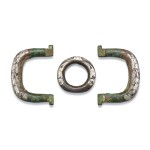
A pair of inscribed silver-inlaid chariot fittings and a silver-inlaid bronze chariot fitting, Western Han dynasty 西漢 銅錯銀「陵里郭氏」銘車馬飾一對 及 銅錯銀車馬飾一件
Auction Closed
November 25, 04:49 AM GMT
Estimate
20,000 - 30,000 HKD
Lot Details
Description
Property of a Gentleman
A pair of inscribed silver-inlaid chariot fittings and a silver-inlaid bronze chariot fitting,
Western Han dynasty
士紳收藏
西漢 銅錯銀「陵里郭氏」銘車馬飾一對 及 銅錯銀車馬飾一件
two inscribed with a four-character inscription reading Lingli Guo shi (Guo of Lingli)
largest l. 7.4 cm
Acquired in Hong Kong in the 1990s.
1990年代購於香港
The two U-shaped fittings in the present lot, also known as yi, were used for guiding the rein; they would be kept firmly in place by insetting the flattened projections onto the horizontal wooden shaft of a chariot. For related chariot fittings bearing Lingli Guo shi (Guo of Lingli) inscription, see a pair of gold and silver-inlaid yi and a silver-inlaid tubular fitting in the National Museum of History, Taipei, accession nos 86-00108 and 88-00021; a silver-inlaid tubular fitting, formerly in the collection of King Gustav VI Adolf and now preserved in the Museum of Far Eastern Antiquities, Stockholm; a pair of gold and silver-inlaid tubular fittings illustrated in Li Xueqin, The Glorious Traditions of Chinese Bronzes, Singapore, 2000, cat. nos 93 d and e; and lots 866 and 867 in this sale.
For further discussion on the origin of Lingli and its related fittings, see Thomas Lawton, 'Some Inscribed Chinese Bronze Fittings in the Singer Collection', New Frontiers in Global Archaeology: Defining China’s Ancient Traditions. Proceedings of the International Symposium Celebrating the Tenth Anniversary of the Arthur M. Sackler Museum of Art and Archaeology at Peking University, New York, 2008, pp. 357-85. See also a pair of related Lingli chariot fittings, from the collection of the late Sir Joseph Hotung, sold in these rooms, 9th October 2022, lot 165.
Dr Lawton mentioned the earliest reference to Lingli appeared in the biography of a Western Han dynasty official, Shi Fen (d. 124 BC), who retired to Lingli after a long and illustrious official career. The annotator of the biography identified Lingli as a village near Maoling County, located in the present-day Xingping City, Shaanxi province. Maoling County was allegedly established to the southeast of the mausoleum of Han Emperor Wudi and developed into a residential area known for its extravagant lifestyle, with a population of over 270,000 housing many wealthy elites.
For further discussion on the origin of Lingli and its related fittings, see Thomas Lawton, 'Some Inscribed Chinese Bronze Fittings in the Singer Collection', New Frontiers in Global Archaeology: Defining China’s Ancient Traditions. Proceedings of the International Symposium Celebrating the Tenth Anniversary of the Arthur M. Sackler Museum of Art and Archaeology at Peking University, New York, 2008, pp. 357-85. See also a pair of related Lingli chariot fittings, from the collection of the late Sir Joseph Hotung, sold in these rooms, 9th October 2022, lot 165.
Dr Lawton mentioned the earliest reference to Lingli appeared in the biography of a Western Han dynasty official, Shi Fen (d. 124 BC), who retired to Lingli after a long and illustrious official career. The annotator of the biography identified Lingli as a village near Maoling County, located in the present-day Xingping City, Shaanxi province. Maoling County was allegedly established to the southeast of the mausoleum of Han Emperor Wudi and developed into a residential area known for its extravagant lifestyle, with a population of over 270,000 housing many wealthy elites.