
Property from an European private collects ion | 歐洲私人收藏
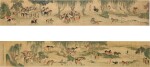
After Zhao Mengfu, Hundred horses | 趙孟頫(款) 百駿圖 設色紙本 二聯 鏡框
Lot Closed
April 20, 10:43 AM GTNN
Estimate
4,000 - 6,000 EUR
Lot Details
Description
Property from an European private collects ion
After Zhao Mengfu
Hundred horses
ink and colour on paper, in four parts, of which the frontipiece and the colophons were mounted as handscrolls, and the main painting was divided in two parts, which are framed and under glass, the painting bearing signature Zhao Mengfu, with two seals, and with one collects or seal
Titleslip bearing signature Gu Da Ding Xing, with one seal
Frontispiece bearing signature Gu Ningyuan, with three seals
Colophons bearing signatures Wen Fenggang, Chen Hongshou and Chen Shi Ting, with five seals
Paintings: 46 x 228 cm; 46 x 243 cm, 18 1/8 by 89 3/4 in.; 18 1/8 by 95 5/8 in.
(4)
__________________________________________________________________________
collects ion particulière européenne
D'après Zhao Mengfu
Cent chevaux, encre et couleurs sur papier, en deux parties, encadrés et sous verre
__________________________________________________________________________
歐洲私人收藏
趙孟頫(款) 百駿圖 設色紙本 二聯 鏡框
鈐印:趙孟頫印、趙氏子昂
鑒藏印:宮保鑒賞
外箋:古大定惺。鈐印:鐂兆□印
引首:顧凝遠(款) 。引首章:月傍九霄多。鈐印:顧凝遠印、青霞
題跋:翁方綱(款) 、陳鴻壽(款)、陳詩庭(款)。引首章:希逸氏。鈐印:翁方綱印、陳鴻壽、曼生、秋景盦
Zhao Mengfu (1254-1322) is an historical scholar, poet and calligrapher, who served at the Yuan dynasty court as high ranking official and became an example of moral rectitude. His works include some of the most famous paintings of horses, including the most renown painting of groom and horses preserved Metropolitan Museum, New York:
https://www.metmuseum.org/art/collects ion/search/40507
He also pained landscapes and rocks:
https://fr.m.wikipedia.org/wiki/Fichier:Zhao_Meng_Fu_Elegant_Rocks_and_Sparse_Trees.jpg.
He promoted Confucians ideals through his colophons and poetry and eventually developed his own style of calligraphy. His work has long been studied and replicated by generations of painters and calligraphers. The present scroll which is based on another related example from the Qing court collects ion can be dated to the Republican period during the early 20th century (1911-1949).
You May Also Like


