
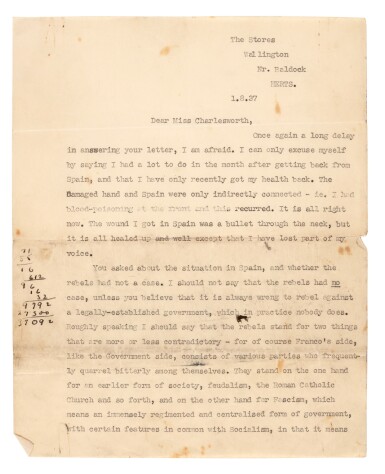
George Orwell | Typed letter signed, to Amy Charlesworth, with his views on the Spanish Civil War, 1 August 1937
Lot Closed
December 13, 04:48 PM GMT
Estimate
6,000 - 8,000 GBP
Lot Details
Description
George Orwell (Eric Arthur Blair)
Typed letter signed ("Eric Blair ("George Orwell")"), to Amy Charlesworth
writing after his return from Spain ("...the wound I got in Spain was a bullet through the neck, but it is all healed up and well except that I have lost part of my voice...") and providing a detailed and nuanced analysis of the opposing sides in the Civil War, the contradictions amongst the Nationalists ("...They stand on the one hand for an earlier form of society, feudalism, the Roman Catholic Church and so forth, and on the other hand for Fascism, which means an immensely regimented and centralised form of government, which certain features in common with Socialism, in that it means suppression of a good deal of private property and private enterprise, but always ultimately in the interest of the bigger capitalists, and therefore completely unsocialistic..."), and the "terrible things" happening on the Government side ("...The Communist Party, which we are accustomed to regard as revolutionary [...] is conducting the reign of terror..."), with an autograph postscript explaining that George Orwell is a pen-name and expressing a desire to meet, 4 pages, 4to, The Stores, Wallington, Nr Baldock, Herts, 1 August 1937, light spotting and dust-staining, nicks at folds
[with:] Photocopy of a letter by Charlesworth to Orwell, discussing The Road to Wigan Pier, 26 May 1937, with George Orwell Archive UCL stamp
This correspondence began when Amy Charlesworth (1904-45) wrote admiringly to Orwell from her home in Stockport after having read The Road to Wigan Pier. She placed herself carefully in class terms ("I am of the working-class but I have been brought into fairly close contact for nine years with the middle-class") and explained she was a student midwife, who had learnt that "there is so much that needs saying about the poor man's wife, and in particular the hardships she undergoes when children come to quickly". She wrote earnestly of the importance of birth control in releasing families from poverty, and hoped that Orwell would write something on the subject. Orwell's reply to this first letter is not known to survive, but he evidently explained that he was recently returned from Spain, leading Charlesworth to ask about the situation in that war-torn country.
Orwell had travelled to Spain to join the Republican left-wing POUM militia after he had finished The Road to Wigan Pier in December 1936. He was involved in the fighting during the Barcelona "May Days" of the Communist purge of of the anti-Stalinist left, was shot in the neck on the Aragon front, and narrowly escaped Spain when the Stalinists outlawed POUM. These experiences, which were the subject of Homage to Catalonia, turned Orwell into a fierce and clear-sighted anti-Communist.
This letter provides a succinct summary of the complex and tragic events in Spain as Orwell saw them. He had returned to England to find little sympathy for his views, as few on the left were willing to accept his argument that Stalinist Communism was nearly identical to Fascism. He was living quietly in rural Hertfordshire working on Homage to Catalonia, although he knew he would be unable to publish it with Victor Gollancz. The book was published the following year by Secker and Warburg.
LITERATURE
The Complete Works of George Orwell: Volume 11 (1998), pp.61-62


