
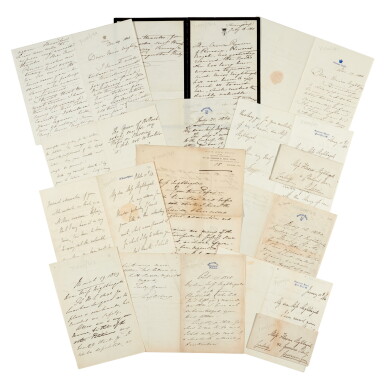
Florence Nightingale | Small archive of c.155 letters addressed to Nightingale by various correspondents, 1854-70
Lot Closed
December 13, 04:46 PM GMT
Estimate
20,000 - 30,000 GBP
Lot Details
Description
Florence Nightingale--Various Correspondents
Small archive of c.155 letters by various correspondents, including royals, politicians, churchmen, and others including members of the International Statistical Congress of 1860, addressed to Florence Nightingale
chiefly relating to her work in nursing and as a social reformer, many letters referring directly to her time in the Crimea, including letters of support before her departure ("... God will Keep you. And my prayer for you will be that your one Object of Worship, Pattern of Imitation, and Source of consolation & strength may be the Sacred Heart of our Divine Lord..." Cardinal Manning, October 1854), praise for her work in the Crimea ("...that heroic woman of whom all true Englishmen are proud has been by Gods providence permitted to see the end of her great Mission of Mercy in the East...", John MacDonald, of The Times), other correspondents recollecting their own war experiences, many letters responding to her later reports and articles on a range of subjects including sanitation, hospital reform, and especially Notes on matters affecting the health, efficiency, and hospital administration of the British army (1858) (a subject "of great National Concern", Lord Palmerston), with a number of letters from royalty showing keen interest in her work ("...This work [i.e. Notes], valuable in itself, bears additional value from recalling benevolent services of which you well Know the Queen's high appreciation…", Prince Albert, 8 November 1858); some letters with marginal annotations in Nightingale's hand, occasionally revealing of her character (“...The Queen of Holland asked me for my notes on nursing. I did not volunteer it. F.N....”); in total c.470 pages, 4to and 8vo, some with envelopes, including a small number of letters addressed to others and forwarded to Nightingale, some marked "private and confidential", 1854-70, occasional fraying and minor staining
A MAJOR GROUP OF LETTERS SHOWING THE DEPTH OF FLORENCE NIGHTINGALE'S INFLUENCE. This correspondence includes letters from many of the most powerful men in Britain in the late 1850s and '60s, as well as statisticians, civil servants, evangelical reformers, and members of the armed forces (or their family members). Almost every letter is marked by a deep respect for Nightingale and her work, and many letters include detailed policy discussion. Gladstone writes about army reform, for example, explaining that "I think it would be a dangerous error to make the soldier's life a life of luxury in relation to that of the class from which he comes: but for his healthful and gainful employment I have long entertained a warm desire"; whilst the Duke of Newcastle, then Secretary of State for the Colonies, writes for Nightingale's opinion on reasons for the decline of native populations in the face of European colonisation, an issue which elicits a long draft response from Nightingale in pencil, mostly on the role of epidemics ("...The main question - namely the disappearance of uncivilized races is one of great difficulty to solve..."). There are letters on cholera, war graves in the Crimea, and correspondence from fellow reformers such as Harriet Martineau, who updates Nightingale on her own writing about soldiers and army reform. There are also a small number of letters that reflect the popular sentimental view of this most unsentimental of women - the "lady of the lamp" - as when the Baptist preacher C.H. Spurgeon responds to her support for charitable work in India:
"I could but pity & despise the man who, calling himself an Englishman, does not consider himself under personal obligation to Florence Nightingale, the Soldier's truest friend " (15 October 1857)
Principal correspondents:
Victoria, Princess Royal (Princess Frederic William of Prussia), five letters (“…Your letter is so excellent, and all the information you give is most valuable, and will be of untold use, not only to me as a guide in my humble endeavours to promote a serious, conscientious, ,and rational spirit in the treatment of sanitary matters, but to many others in Germany…”, 24 December 1868)
Augusta of Saxe-Weimar-Eisenach, Queen of Prussia
Sophie of Württemberg, Queen of the Netherlands, four letters
Pedro V, King of Portugal
Prince Albert
Prince George, Duke of Cambridge (three letters)
Anthony Ashley-Cooper, 7th Earl of Shaftesbury (12 letters, "…You have achieved very grand things; & you must thank God that He has called you to such a work, and has so blessed it . . .in England, under the mask of Humanity & Greatness, there is a larger amount of what is mean and cruel, than in any Country I am acquainted with…")
Sir Harry Verney, 2nd Baronet (three letters)
George Frederic Watts (on sittings for a planned portrait of Nightingale)
Jenny Lind
William Gladstone, four letters, 1862-64
Lord Palmerston, two letters
Henry, 3rd Earl Grey
Edward Stanley, 15th Earl of Derby, six letters
Sir James Paget, surgeon and pathologist, four letters
Angela Burdett-Coutts
Henry Pelham-Clinton, 5th Duke of Newcastle, five letters
Lord John Russell
Cardinal Manning, five letters, including three written in October 1854
Harriet Martineau ("…your suffering condition [...] is never a day out of my mind...")
George, 1st Marquess of Ripon, later Earl de Grey, fourteen letters
Sir William Jenner, two letters
John MacDonald, four letters
Arthur Hugh Clough
Mary Carpenter
C.H. Spurgeon
George, 4th Earl of Clarendon
George, Earl de Grey and Ripon, fourteen letters
Henry, 5th Duke of Newcastle, five letters
Adolphe Quetelet, three letters
PROVENANCE
Sotheby's, London, 15 December 1987, lot 224


