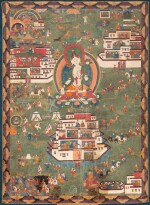

Property from the collection of Richard R. and Magdalena Ernst | 恩斯特伉儷收藏
A thangka depicting Nangsa Wöbum as Sitatara, Tibet, circa 19th century | 西藏 約十九世紀 白度母唐卡 設色布本
Lot Closed
December 15, 11:07 AM GMT
Estimate
4,000 - 6,000 EUR
Lot Details
Description
Property from the collection of Richard R. and Magdalena Ernst
A thangka depicting Nangsa Wöbum as Sitatara
Tibet, circa 19th century
distemper on cloth, seated in vajraparyankasana on a lotus in a mountainous landscape, with temples and monastery complexes and scenes from the life of Nangsa Wöbum, all surrounded by a cloud border
82 x 59 cm, 32 1/4 by 23 1/4 in.
__________________________________________________________________________
Collection Richard R. & Magdalena Ernst
Tangka représentant Nangsa Wöbum en Sitatara, détrempe sur toile, Tibet, circa XIXe siècle
__________________________________________________________________________
恩斯特伉儷收藏
西藏 約十九世紀 白度母唐卡 設色布本
“Dieux et démons de l’Himâlaya: Art du Bouddhisme lamaïque”, Grand Palais, Paris, 25 March-27 June 1977; and Haus der Kunst, Munich, 5 August-16 October 1977.
"Legends and Myths in Himalayan Art: Once Upon Many Times", The Rubin Museum of Art, New York, 16 September 2011-30 January 2012.
__________________________________________________________________________
《喜瑪拉雅之神與魔 : 藏傳佛教藝術 》,大皇宮,巴黎,1977年3月25日至6月27日;藝術之家,慕尼黑,1977年8月5日至10月16日
《喜瑪拉雅藝術之傳說與迷思 : 很久很久以前》,魯賓藝術博物館,紐約,2011年9月16日至2012年1月30日
Jeannine Auboyer and Gilles Béguin, Dieux et démons de l'Himâlaya: Art du Bouddhisme lamaïque, Paris, 1977, cat. no. 189.
Elena Pakhoutova, Legends and Myths in Himalayan Art: Once Upon Many Times, New York, 2011, pp. 10-11, fig 10.
Himalayan Art Resources item no. 77095.
__________________________________________________________________________
Jeannine Auboyer and Gilles Béguin,《喜瑪拉雅之神與魔 : 藏傳佛教藝術 》,巴黎,1977年,編號189
Elena Pakhoutova,《喜瑪拉雅藝術之傳說與迷思 : 很久很久以前》,紐約,2011年,10-11頁,圖10
喜瑪拉雅藝術資源,物件編號77095
The painting depicts the life story of a beautiful Tibetan woman, Nangsa Wöbum, depicted here as Sitatara, of whom she is considered an emanation. This story is a popular subject often re-enacted in Tibetan opera. Nanga Wöbum suffered in an unhappy marriage and was abused by her husband and her husband's family, only to die from grief. Due to her good karma, she was returned to life by the Lord of Death, wherein she became a nun and devoted her life to sharing the Buddhist teachings with those same people who had earlier wronged her.
__________________________________________________________________________
本唐卡紀載一名美麗藏族婦女Nangsa Wöbum的一生,她被認為是白度母原身。這則家喻戶曉的故事常在西藏戲曲重新演繹。Nangsa Wöbum在不幸福的婚姻中受盡折磨,被丈夫和親家虐待,最後因悲痛而死。由於她的善業,她被死亡之神送回人間並成為了一名尼姑,將其一生奉獻給那些早先虐待過她的人,分享佛教教義。