
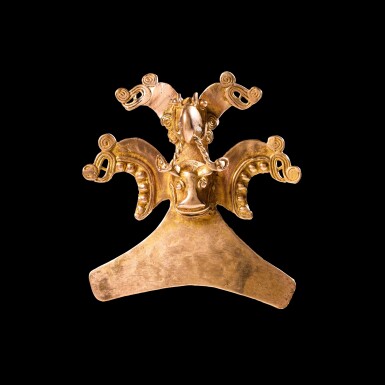
Pendentif zoomorphe en or, Veraguas / Chiriquí, ca. 800-1500 AP. J.-C. | Veraguas / Chiriquí Gold Zoomorphic Pendant, ca. AD 800-1500
Lot Closed
December 16, 02:03 PM GTNN
Estimate
15,000 - 25,000 EUR
Lot Details
Description
Pendentif zoomorphe en or, Veraguas / Chiriquí, ca. 800-1500 AP. J.-C.
haut. 10.5 cm ; 4 1/6 in
Veraguas / Chiriquí Gold Zoomorphic Pendant, ca. AD 800-1500
collects ion privée, active dans les années 1960-1970
Sotheby’s, New York, 9 mai 2006, n° 123, consigné par les précédents
collects ion privée nord américaine, acquis lors de la précédente vente
La superposition spectaculaire de deux animaux totémiques sur ce pendentif est une démonstration du pouvoir de transformation. La capacité du chaman à faire appel aux forces surnaturels afin de se changer en créatures divines était en effet un pouvoir respecté. Donner une identité visuelle à cette transformation était une prérogative de l'orfèvre.
La figure principale de ce pendentif est l'oiseau à tête d'aigle, moulé avec des ailes déployées qui se transforment en têtes de félins hargneux, le bord inférieur des ailes est garni de perles. Le ventre de la figure est une tête de félin qui sert de hochet. L'aigle saisit deux serpents dans son bec épais, tandis que les touffes de plumes au sommet de sa tête se transforment en têtes de jaguar. Une boucle de suspension se trouve à l'arrière du cou.
Voir Alan Wardwell, The Gold of Ancient America, 1969, New York, fig. 102, un pendentif similaire au Museum of Replica Handbags s, Boston (Inv. 22.286).
The dramatic layering of totemic animals on this pendant is an ebullient display of power and transformation. The ability of the shaman to call upon supernatural powers and suggest the transformation into the creatures of their world, was a respected duty. Giving a visual identity to this transformation was an honored role of the goldsmith.
The primary figure on this pendant is the eagle-headed bird, cast with outspread wings that are transforming into snarling feline heads, the lower rim of the wings are trimmed by beadwork. The belly of the figure is a feline head that serves as a rattle. The eagle grasps two snakes in its thick beak, and the feather tufts at the top of its head similarly transform into jaguar heads. There is a suspension loop at the back of the neck.
See Alan Wardwell, The Gold of Ancient America, 1969, New York, fig. 102, for a similar avian in the Museum of Replica Handbags s, Boston (Acc. nbr. 22.286).
You May Also Like


