
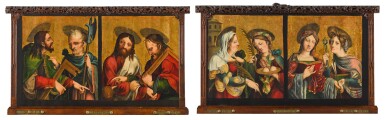
Maestro de la Santa Cruz
Saints Thomas, Jude the Apostle, Luke and James the Lesser; and Saints Barbara, Agatha, Ursula and Apollonia
Lot Closed
October 19, 03:55 PM GMT
Estimate
30,000 - 50,000 GBP
Lot Details
Description
Maestro de la Santa Cruz
Active in Burgos circa 1530 - 1540
Saints Thomas, Jude the Apostle, Luke and James the Lesser; and Saints Barbara, Agatha, Ursula and Apollonia
a pair, both oil on gold ground panel
each unframed: 93.3 x 160 cm.; 36¾ x 63 in.
each framed: 104.5 x 178.3 cm.; 41⅛ x 70¼ in.
(2)
We are grateful to Dr Isabel Mateo Gómez for proposing the attribution to Andrés de Melgar, previously identified as the Maestro de la Santa Cruz, on the basis of photographs.
The artist referred to as the Maestro de la Santa Cruz was believed to have been active during the first half of the 16th century in Burgos, one of the most important cities in the Iberian Peninsula. His nomenclature derives from paintings in the Cartuja de Miraflores, just outside Burgos, depicting the Story of the True Cross, which compare closely to the present panels.
Recently he has been identified with the painter Andrés de Melgar (Sahagún circa 1501 – circa 1555 Santo Domingo de la Calzada), who trained with Alonso Berruguete (circa 1488-1561), son of Pedro Berruguete, who worked in Valladolid, to the southwest of Burgos. Melgar settled in Santo Domingo de la Calzada, just to the east of Burgos, in 1530. His work is characterised not only by Berruguete's style, but also by rather Italianate, mannerist touches, reminiscent of the work of other Spanish artists influenced by Leonardo, such as Fernando Yáñez (1459-1536) and Hernando de los Llanos (1480-1510).
The disposition of the saints in these panels strongly suggests that they were once components of a larger altarpiece, most probably forming part of the predella, or perhaps sections of wings. The black borders would originally have been covered by sculpted framework.