
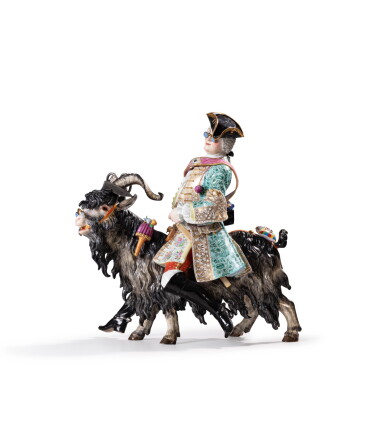
A Dresden porcelain figure of Count Bruhl’s tailor, late 19th century | Groupe en porcelaine Dresde d'après un modèle du Comte Brühls Tailor, fin du XIXeme siècle
Lot Closed
November 19, 02:51 PM GTNN
Estimate
6,000 - 10,000 EUR
Lot Details
Description
A Dresden porcelain figure of Count Bruhl’s tailor, late 19th century
partially legible mark in blue, incised numeral 107 (restorations)
Height 17¾in; width 13¾in; prof 10⅔in
__________________________________________________________________________
Groupe en porcelaine Dresde d'après un modèle du Comte Brühls Tailor, fin du XIXeme siècle
marque bleue en partie illible, le numéro 107 incisé (restaurations)
Haut. 42,5 cm, larg. 35 cm, prof. 27 cm
Count Heinrich von Brühl (1700-1763) was Minister of the Interior of Saxony for August III. He was appointed Director of the Meissen factory in 1733 and held the position until his death. By tradition the Count's ambitious tailor requested an invitation to dine at court. In response and to put him in his place, the Count requested Kändler to make a figure of the tailor so that he could place him at the dining table.
The fame of the group extended into the 19th century. An example was exhibited at the Great Exhibition, in 1851 and described by John Tallis, History and description of the Crystal palace, and the Exhibition of the world's industry, (Band 1), 1851, p.153:
'The grotesque figures and groups of Dresden porcelain have always been admired for their execution, if not for their style. The cost.mes s are especially admirable, and the representation of fine work, such as lace, truly wonderful. Some specimens of this were seen in the Exhibition. One of the grotesque pieces which obtained most celebrity, and was familiar to all amateurs, was the famous tailor of the Count de Bruhl, a figure which was remarkable for the difficulty of its execution, owing to the numerous accessories it included. The figure of the tailor was represented riding on a goat surrounded with all the implements and appendages of his trade, and was about 20 inches in height'.


