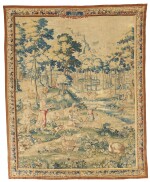

A Flemish July/August Seasons Tapestry, Brussels or Bruges, second half 17th century
Lot Closed
November 9, 03:38 PM GTNN
Estimate
12,000 - 18,000 GBP
Lot Details
Description
A Flemish July/August Seasons Tapestry, Brussels or Bruges,
second half 17th century
woven with landscape setting depicting various figures picnicking, walking, hunting in a river landscape, the foreground with various birds and onlooking fox, the background with formal gardens and woodland and distant fortified town on the horizon, within a narrow floral border, the top section centered with a blue entablature with inscription IULIUS / AUGUSTUS, with later outer selvedge
approximately 287cm. high, 237cm. wide; 9ft. 5in., 7ft. 9¼in.
Edith Appleton Standen, European Post.mes dieval Tapestries in the Metropolitan Museum, 1985, Vol. I, pp.331-333, 349-351.
J. C. Webster, The Labours of the Months in Antique and Medieval Art to the End of the Twelfth Century, Princeton 1938 Vertue 1930 George Vertue, 1930: Notebooks’, vol.I, The Walpole Society, Oxford, Vol.XVIII (1929–30).
Helen Wyld, 'Seventeenth-century Tapestries at Ham House', in Christopher Rowell (ed.), Ham House: 400 Years of collects ing and Patronage, New Haven and London 2013, pp. 178-93.
Traditionally known as Les Mois de Lucas, a set of tapestries representing the Months of the Year are thought to have been originally designed by a Flemish artist from the school of Bernard van Orley, known as the Master of the Months of Lucas, circa 1535, Brussels (now lost). Later sets (now in Paris, Mobilier National, and New York, Metropolitan Museum), though woven at the Gobelins manufactory, Paris in the 18th century, were designed after the 1535 Netherlandish tapestry set. The resulting works successfully combines a Renaissance sensibility in subject matter, compositional style, and clothing fashions with an exuberant architectural Rococo border, bright colour palette, and highly accomplished weaving techniques, serving as inspiration for variations of the subjects. Both the original Brussels-woven series and the Gobelins re-edition proved exceedingly popular and were woven multiple t.mes s.
The arrangement of the subjects align to the months and seasons of the year and the appropriate activities of each. Representations of the labours of the months have their origin in early Christian calendars and were associated with the signs of the zodiac and signified the passing of celestial and terrestrial t.mes until the Second Coming and the Last Judgement. The iconography of the months focusing on their associated agricultural activities was developed in the illuminated manuscripts of medieval books of hours. During the fourteenth century these scenes were often expanded into representations of daily life, a very accomplished example being the 'Très-Riches Heures' (1411-1413), by the Limbourg brothers for Jean, Duc de Berry. For a comparable subject for the present tapestry, see Le Dejeuner des chausseurs, from the Livres de la Chasse de Gaston Phoebus, Paris, circa 1405-1410 (Paris, Bibliotheque nationale, Mss. Fr. 616, fol 67.).
The subject of the labours of the months was very popular in tapestry design from the early sixteenth century. A number of important series were designed between circa 1520-1540, including the so called ‘Medallion Months’, the ‘Seasons of Lucas’ and the 'Months of Lucas'. There was also the famous 'Hunts of Maximilian' series, which was also copied at the Gobelins manufactory (17th century, workshop of Jean de la Croix), in Brussels (originally in the 16th century and variants later in 17th century, Leyniers workshop). Interpretations of the seasons/months subjects were woven in England (17th century, London, Mortlake workshop, Melbury Months, Private collects ion), and in Bavaria (twelve commissioned for Maximilian I, Elector of Bavaria, 1604-1615, Munich, workshop of Hans van der Biest, Munich, Residenz Museum). There is an interesting set of Bruges tapestries of the months, woven in 1666 for the wedding of the Emperor Leopold I, within floral borders and although the principle groups of figures are much smaller in scale in the present tapestry, the subjects of July and August (both in Vienna, Kunsthistorisches) are comparable, in being groups of men and women picnicking and relaxing in the countryside.
Although the iconography was never identical, border types varied and the zodiac signs were not always incorporated, there were certain activities which came to be associated with each month or season, including the sheep shearing or the hunt breakfast in June, haymaking or preparing for the hunt in July and harvesting or the hunt in August. However the identification of the different months in some series panels is somewhat arbitrary for some panels. The present panel in subject alludes to a hunt breakfast and the hunt, covering the months of June, July and August and therefore the summer season. It is not unusual to think of July and August together as the summer months and therefore does not detract from adhering to the original 1535 inspired designs of Seasons or Months tapestries.
You May Also Like


