
Property from Charleton House, Fife
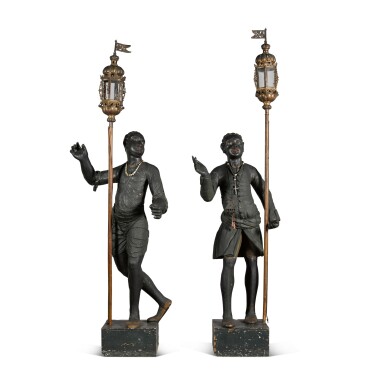
A pair of Italian near-lifesize polychrome decorated figural standard bearers, Venice, 18th century
Lot Closed
January 14, 03:24 PM GMT
Estimate
15,000 - 25,000 GBP
Lot Details
Description
Property from Charleton House, Fife
A pair of Italian near-lifesize polychrome decorated figural standard bearers, Venice, 18th century
each near life-size form supporting an oak pole with later gilt-copper repoussé lanterns, redecoration
figures 192cm. and 185cm. high; 6ft. 3 1/2in., 6ft. 3/4in. lamp standards 248cm. high; 8ft. 1 1/2in.
Her daughter Grizel Ansthruther-Thompson, Baroness Knunt Bonde (1882-1970);
thence by descent.
Scottish Field, January 1990, photographed in the dining room for the front cover;
William Kay, 'Charleton, Fife', Country Life, 22 February 1990, p.99, photographed in the dining room.
Agnes Anstruther-Thomson was the daughter of James Alexander Guthrie, a director of the Bank of England. In 1882, she married the prominent Scottish landowner Charles Anstruther-Thomson (1855-1922). A fashionable member of London society, she held salons at the couple’s townhouse in Rutland Gate. Her sister-in-law, the writer and artist Clementina Anstruther-Thomson (1857–1921), was a close friend and student of John Singer Sargent, Agnes sat for Sargent in 1898 as Clementina had a decade earlier in 1889.
Charles and Agnes undertook extensive alterations to the house and gardens when Charles inherited the estate in 1904. Robert Lorimer (1864–1929) was commissioned to redesign the 18th century house. He created a new formal entrance on the north side, replete with a screen-wall incorporating busts and created an extraordinary set of interior spaces, including a long hall or gallery running north to south. These altered spaces gave Agnes the opportunity to display, not only inherited family pieces, but also her own acquisitions, which included salvaged architectural fragments. This combination of Lorimer's use of revival vernacular detail and Agnes' historic fixtures is a theatrical tour de force. It included the installation in the dining room of an imposing Italian classical door frame around the chimney-piece, said to have been acquired from the artist Sargent. It was this dramatic feature, where the figures offered here were positioned.