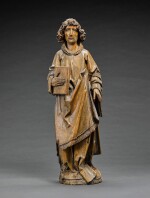

Workshop of Tilman Riemenschneider (circa 1460-1531) | German, Würzburg, circa 1510-1520 | Standing Deacon
Lot Closed
July 6, 02:03 PM GTNN
Estimate
30,000 - 50,000 GBP
Lot Details
Description
Workshop of Tilman Riemenschneider (circa 1460-1531)
German, Würzburg, circa 1510-1520
Standing Deacon
limewood
with a label to the underside inscribed: Kunstsammlung Emil Georg Bührle, Zürich / KÜNSTLER: Tilman Riemenschneider / TITEL: Diakon I / AUSGEFÜHRT IM JAHRE: um 1490, and with another label printed: 23
52.5cm., 20¾in.
Private collects
ion, Frankfurt, by 1921;
August Carl, Zurich;
Emil G. Bührle, Zurich (acquired from August Carl in September 1952);
private collects ion, Switzerland
August Carl, Zurich;
Emil G. Bührle, Zurich (acquired from August Carl in September 1952);
private collects ion, Switzerland
Mittelalterliche Bildwerke aus Frankfurter Privatbesitz, Frankfurter Kunstverein, Frankfurt, 1921, no. 21
O. Schmitt and G. Swarzenski, Meisterwerke der Bildhauerkunst in Frankfurter Privatbesitz, Frankfurt a. M., 1921, vol. 1, no. 136
This sensitively carved figure of a Deacon is attributable to the workshop of Tilman Riemenschneider, the most celebrated of the Southern German limewood sculptors, who was active in Franconian Würzburg. When it was exhibited in Frankfurt in 1921 alongside a companion figure, the sculpture's affinity with Riemenschneider’s work was clearly recognised, as it carried an attribution to the master himself.
Formerly identified as Saint Lawrence, the standing figure wears the fringed garment of a deacon, an Officer of the Church responsible for ministering to the poor. A compositional parallel from Riemenschneider's oeuvre is found in a Saint Lawrence in the Cleveland Museum of Art (inv. no. 1959.42), which is thought to have been carved as part of an altarpiece for the Dominican convent in Rothenburg around 1502-1508. The drapery scheme shared by the figures – with elaborate gathering at the centre of the body and tight bunching around the feet – can be observed in many of the smaller scale figures of Riemenschneider’s altarpieces of the first two decades of the 15th century. The present Deacon’s face too is characteristic of the master’s style, marked by an oblong shape, slanting eyes, a prominent, straight bridge of the nose, and small pursed lips. Framed by vigorously curled, shoulder-length hair, it follows a facial type Riemenschneider repeatedly returned to after the 1490s for youthful male figures, including in his Reliquary Bust of a Saint in the Bayerisches Nationalmuseum, Munich (inv. no. MA 1336; Weniger, op. cit., no. 5). The present figure’s pronounced slanting of the eyes and more simplified treatment of facial features and drapery indicate an origin among Riemenschneider’s assistants, for whom the master produced small-scale models for copying to satisfy demand in his most successful years. A possible dating of the present Deacon in the later phase of Riemenschneider’s career, around 1515-1520, is supported by a comparison with the Saint Stephen in the Mainfränkisches Museum, Würzburg (inv. no. H 14063; Lichte, op. cit., no. 40) who, though seated, mirrors the pose of the upper body and shows a similarly self-contained composition, with a calm flow in the drapery.
RELATED LITERATURE
C. Lichte et al., Tilman Riemenschneider: Werke seiner Blütezeit, 2004, pp. 292-299; M. Weniger, Tilman Riemenschneider: Die Werke im Bayerischen Nationalmuseum, Petersberg, 2017
Formerly identified as Saint Lawrence, the standing figure wears the fringed garment of a deacon, an Officer of the Church responsible for ministering to the poor. A compositional parallel from Riemenschneider's oeuvre is found in a Saint Lawrence in the Cleveland Museum of Art (inv. no. 1959.42), which is thought to have been carved as part of an altarpiece for the Dominican convent in Rothenburg around 1502-1508. The drapery scheme shared by the figures – with elaborate gathering at the centre of the body and tight bunching around the feet – can be observed in many of the smaller scale figures of Riemenschneider’s altarpieces of the first two decades of the 15th century. The present Deacon’s face too is characteristic of the master’s style, marked by an oblong shape, slanting eyes, a prominent, straight bridge of the nose, and small pursed lips. Framed by vigorously curled, shoulder-length hair, it follows a facial type Riemenschneider repeatedly returned to after the 1490s for youthful male figures, including in his Reliquary Bust of a Saint in the Bayerisches Nationalmuseum, Munich (inv. no. MA 1336; Weniger, op. cit., no. 5). The present figure’s pronounced slanting of the eyes and more simplified treatment of facial features and drapery indicate an origin among Riemenschneider’s assistants, for whom the master produced small-scale models for copying to satisfy demand in his most successful years. A possible dating of the present Deacon in the later phase of Riemenschneider’s career, around 1515-1520, is supported by a comparison with the Saint Stephen in the Mainfränkisches Museum, Würzburg (inv. no. H 14063; Lichte, op. cit., no. 40) who, though seated, mirrors the pose of the upper body and shows a similarly self-contained composition, with a calm flow in the drapery.
RELATED LITERATURE
C. Lichte et al., Tilman Riemenschneider: Werke seiner Blütezeit, 2004, pp. 292-299; M. Weniger, Tilman Riemenschneider: Die Werke im Bayerischen Nationalmuseum, Petersberg, 2017
You May Also Like


