
Property of a Private Swiss Collector
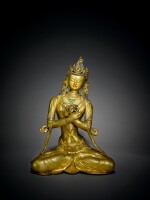
A Gilt Copper Alloy Figure of Vajradhara, Tibet, 15th/16th Century
Auction Closed
September 20, 05:33 PM GMT
Estimate
100,000 - 120,000 USD
Lot Details
Description
Property of a Private Swiss Collector
A Gilt Copper Alloy Figure of Vajradhara
Tibet, 15th/16th Century
Height 13⅜ in. (34 cm)
the Dhyani Buddha Vajradhara seated in vajraparyankasana, his hands crossed in front of his chest in vajrahumkaramudra holding a ghanta in the left hand and a vajra in the right, signifying the union of wisdom and compassion, wearing a five-pronged crown with his long tresses arranged in an elegant topknot surmounted by a vajra finial, adorned in a rich suite of accoutrements or bodhisattvabharana inlaid with turquoise and lapis lazuli
Himalayan Art Resources item no. 13478.
This elegant gilded image of the primordial buddha Vajradhara is characteristic of Tibetan sculpture during the fifteenth and sixteenth centuries that incorporated stylistic elements of early Ming period (1368-1643) Chinese traditions. The loose fitting lower garment with raised folds of cloth is typical of the majority of Yongle (1403-1424) and Xuande (1426-1435) period seated bronzes. The scarf draped over the shoulders passing over the arms with loops extending at the elbow is a feature often seen in Xuande period sculpture, such as the Amitayus formerly in the Philip Goldman Collection and the large Amitayus in Tibet House, New Delhi, see Ulrich von Schroeder, Indo-Tibetan Bronzes, Hong Kong, 1981, pp. 522-25, pls. 147C & 148B. Compare the long and slim proportions of the torso, the delicate physiognomy and the slender hands of a fifteenth or sixteenth century Tibetan gilt copper figure of Nagarjuna in the Mr. and Mrs John G. Ford Collection, ibid, pp. 442-43, pl. 119E, and Jeff Watt, HAR no. 73877.
You May Also Like


