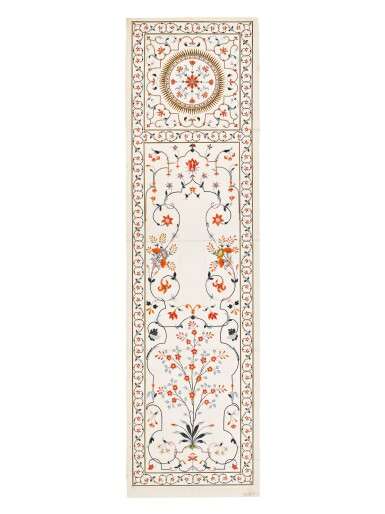
A pietra dura architectural study of the top of the Cenotaph of Shah Jahan in the Taj Mahal, Company School, Agra, circa 1810-20
Auction Closed
October 27, 10:37 AM GMT
Estimate
20,000 - 30,000 GBP
Lot Details
Description
pencil, pen and ink, opaque watercolour on paper, composed of three sheets joined together, two of the three sheets watermarked 'E & P 1805', inscribed in ink at lower right ''Top of the Emperor’s/ Tomb.''
184 by 51 cm. (72 ½ by 20 ⅛ in.)
Private collection, Scotland
Simon Ray, Islamic and Indian Works of Art, London, 2012
Simon Ray, Islamic and Indian Works of Art, London, 2012
Simon Ray, Islamic and Indian Works of Art, London, 2012, no.82
The cenotaph of Mumtaz Mahal (d.1632) lies at the centre of the Taj Mahal beneath the large dome, alongside the cenotaph of her husband, the Mughal emperor Shah Jahan (d.1666). The present illustration is a large study of the top of Shah Jahan’s cenotaph. Decorated with semi-precious stones inlaid into marble in the pietra dura technique, the top of the cenotaph has a shamsa or sunburst set within a square, and the rest of the rectangular panel bears elegant floral scrolling designs. The shamsa on the cenotaph is an imperial symbol and echoes the decoration at the apex of the main dome of the Taj Mahal. In comparison, the top of Mumtaz Mahal’s cenotaph is decorated with a series of Qur’anic verses. The actual tombs of Shah Jahan and Mumtaz Mahal are in a chamber directly beneath their cenotaphs.
Drawings of the tops and side elevations of the cenotaphs of Shah Jahan and Mumtaz Mahal, along with views of the Taj Mahal, would often be included in early nineteenth century architectural albums of Mughal monuments produced by Agra draughtsmen for British patrons. Studies of Mughal pietra dura decoration were much admired by the British. The tops of both cenotaphs would either be illustrated together on the same sheet of paper or individually.
Two individual life-size illustrations of the tops of both cenotaphs were commissioned by Lady Nugent in 1812 and are now in the British Library. Illustrations of the top of Shah Jahan’s cenotaph include one in the Victoria and Albert Museum in London, dated to circa 1820 (acc.no.D.1546-1886; Archer 1992, p.142); another in the Bibliothèque nationale de France, Paris, dated to circa 1815 (Hurel 2010, no.285-8 (f.8), p.226-7). A further example, attributed to the Agra artist Shaikh Latif, was sold recently in these rooms, 10 June 2020, lot 147.
Drawings of the tops and side elevations of the cenotaphs of Shah Jahan and Mumtaz Mahal, along with views of the Taj Mahal, would often be included in early nineteenth century architectural albums of Mughal monuments produced by Agra draughtsmen for British patrons. Studies of Mughal pietra dura decoration were much admired by the British. The tops of both cenotaphs would either be illustrated together on the same sheet of paper or individually.
Two individual life-size illustrations of the tops of both cenotaphs were commissioned by Lady Nugent in 1812 and are now in the British Library. Illustrations of the top of Shah Jahan’s cenotaph include one in the Victoria and Albert Museum in London, dated to circa 1820 (acc.no.D.1546-1886; Archer 1992, p.142); another in the Bibliothèque nationale de France, Paris, dated to circa 1815 (Hurel 2010, no.285-8 (f.8), p.226-7). A further example, attributed to the Agra artist Shaikh Latif, was sold recently in these rooms, 10 June 2020, lot 147.
You May Also Like


