
Property from a Private collects ion 私人收藏
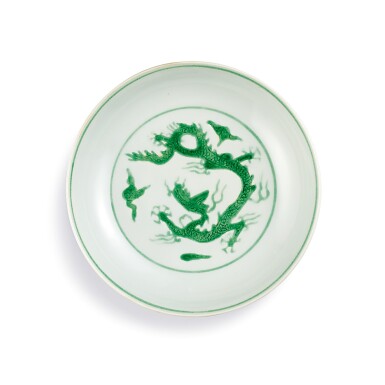
A fine and rare incised green-enamelled 'dragon' dish Mark and period of Zhengde | 明正德 白地暗刻海水素胎綠彩雲龍紋盤 《大明正德年製》款
Auction Closed
April 22, 07:57 AM GTNN
Estimate
800,000 - 1,200,000 HKD
Lot Details
Description
Property from a Private collects ion
A fine and rare incised green-enamelled 'dragon' dish
Mark and period of Zhengde
私人收藏
明正德 白地暗刻海水素胎綠彩雲龍紋盤 《大明正德年製》款
the interior decorated with a central medallion enclosing a five-clawed dragon writhing amidst stylised ruyi-shaped clouds, the exterior incised with two five-clawed dragons striding against an incised wave ground, the base inscribed in underglaze blue with a six-character reign mark, Japanese wood box
17.7 cm
collects ion of Hikonobu Ise.
伊勢彥信收藏
Imperial porcelain dishes with green-enamelled dragon designs first appeared in the Chenghua period (1465-87), with and somet.mes s without reign marks. More were manufactured in later periods of the Ming dynasty, particularly during the Hongzhi (r. 1488-1505) and Zhengde (r. 1506-21) periods, and almost always with reign marks. The various periods of the Qing dynasty spanning from Kangxi (r. 1662-1722) to Guangxu (r. 1875-1908) also saw the production of ‘green dragon’ dishes, demonstrating their importance as a classic and representative type of porcelain favored at the Ming and Qing imperial courts. As well as saucer-shaped dishes, matching bowls were made in this decorative scheme. While dragons on most Qing dishes are only painted over the glaze in green, on Ming examples they are usually first incised and reserved in the biscuit during firing and their silhouettes were then filled with green enamel for a second firing. This extra procedure of incising gives a somewhat three-dimensional touch to the finished product.
Closely related dishes include one in the British Museum, London, published in Jessica Harrison-Hall, Ming Ceramics in the British Museum, London, 2001, pls 8: 33-35; and another in the Shanghai Museum, illustrated in Lu Minghua, Shanghai Bowuguan zangpin yanjiu daxi/Studies of the Shanghai Museum collects ions: A Series of Monographs. Mingdai guanyao ciqi [Ming imperial porcelain], Shanghai, 2007, pl. 1-44.
Although there are a few other similar dishes in private hands, the present example is impressive for the sumptuous glossiness of its glaze and enamel, particularly evident in the bright green on the exterior. Compare a dish of this size and design in the Leshantang collects ion, published in The Leshantang collects ion of Chinese Porcelain, Taipei, 2005, pl. 18; another from the British Rail Pension Fund sold four t.mes s in our rooms, in London, 13th December 1966, lot 73; 1st July 1969, lot 149; and 17th November 1970, lot 76, and in Hong Kong, 16th May 1989, lot 27; and a further example, from the collects ions of Neil F. Phillips, the Reach Family, and the Meiyintang collects ion, sold in these rooms, 9th October 2012, lot 21.
For dishes of this design, yet larger in size, see one from the collects ions of R.H.R. Palmer and Edward T. Chow, included in the Oriental Ceramic Society exhibition Polychrome Porcelain of the Ming and Manchu Dynasties, London, 1950, cat. no. 77, sold in our London rooms, 27th November 1962, lot 18 and again in these rooms, 25th November 1980, lot 37; and a second dish from the Edward T. Chow collects ion, sold in these rooms, 19th May 1981, lot 447.